
Sleep problems
How Much Sleep Do Adults Need? Is 8 Hours Really Necessary?
Eight hours is a useful reference, not a nightly score. Find out what the adult sleep range means and how to think about your own pattern.
Checked against NHS and other linked sources on 2 October 2026. Not reviewed by a doctor. How guides are made
The short answer
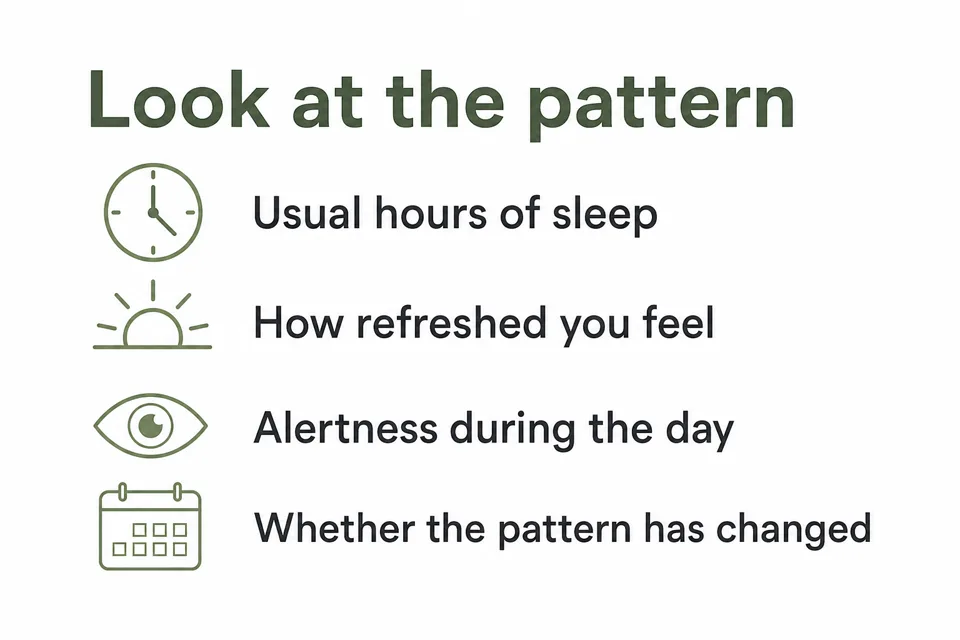
Most healthy adults need around 7 to 9 hours of sleep a night, but eight hours isn't a magic target that everyone needs to hit. Your individual sleep need can vary, and the amount that works for you may not be exactly the same as someone else's. Rather than judging your sleep by one number alone, look at the wider pattern: how long you usually sleep, how refreshed you feel when you wake, how alert you are during the day and whether you're regularly struggling with tiredness or sleepiness.
This guide is general information, not medical advice. If you are worried about your symptoms, speak to a GP or pharmacist.

Eight hours has become the number many of us associate with a “proper” night's sleep.
Sleep for less than that and it can feel as though you've failed before the day has even started. Get seven hours and you might wonder whether you should have stayed in bed longer. Sleep for nine and you may question whether you've slept too much.
But the eight-hour rule is not quite as precise as it sounds.
Do adults really need 8 hours of sleep?
Not necessarily.
Eight hours sits comfortably within the usual range for adults, but it shouldn't be treated as a nightly pass-or-fail test.
The NHS gives 7 to 9 hours as the average adult range. Its Every Mind Matters guidance also makes an important point: age, health and daily routine can affect how much sleep an individual needs.
That means two adults can have slightly different sleep requirements without either of them necessarily sleeping incorrectly.
One person might regularly sleep for around seven and a half hours and function well. Another might naturally need closer to nine.
The more useful question is therefore not:
“Did I get eight hours?”
It's:
“Am I regularly getting enough sleep for me?”
That distinction matters because chasing an exact number can turn sleep into another performance target.
Why does everyone talk about eight hours?
Eight hours is useful as a simple shorthand because it sits around the middle of the commonly recommended adult range.
It is much easier to remember than explaining all the individual variation that sits behind it.
Research also broadly supports a range rather than a universal eight-hour requirement. An overview of systematic reviews involving data from millions of participants found that around 7 to 8 hours per day was most favourably associated with health outcomes in adults and older adults. PubMed
That doesn't mean seven hours is perfect or that eight hours guarantees better health.
Much of the research looking at sleep duration and long-term health is observational. It can identify associations, but it cannot always tell us whether the amount of sleep itself caused a particular outcome.
That's particularly important when interpreting studies about unusually long sleep. Longer sleep can sometimes accompany health problems rather than cause them. A systematic review examining sleep duration and mortality specifically noted that underlying illness could help explain some of the association seen with long sleep. PubMed
So the evidence shouldn't be turned into a stopwatch.
For everyday purposes, 7 to 9 hours is a useful guide, not a nightly prescription.
Is 7 hours of sleep enough?
For many adults, it can be.
Seven hours falls within the NHS's general range for healthy adults.
But simply reaching seven hours doesn't automatically tell you that you're getting enough sleep.
Consider what happens during the day.
Do you generally wake feeling reasonably refreshed? Can you concentrate on ordinary tasks? Do you have enough energy to get through your normal day? Are you frequently fighting the urge to fall asleep?
The NHS similarly recommends looking at daytime functioning when judging whether you're getting enough sleep. Feeling refreshed, having enough energy and being able to focus are useful clues.
A person consistently sleeping seven hours and functioning well is in a different situation from someone sleeping the same amount but struggling to stay awake every afternoon.
The number needs context.
Is 6 hours of sleep enough?
Six hours is below the usual 7-to-9-hour range recommended for most healthy adults.
That doesn't mean you need to worry because you occasionally sleep for six hours. A short night happens.
The more useful distinction is between an occasional short night and a regular pattern.
If you're consistently getting around six hours because work, late nights, caring responsibilities or your routine only allow that much time for sleep, you may simply not be giving yourself enough opportunity to sleep.
There is also a difference between:
“I only allow myself six hours in bed.” and: “I give myself plenty of opportunity to sleep but naturally wake after six hours.”
If six hours is your regular pattern and you're also constantly tired or sleepy during the day, it's worth paying attention to that combination rather than reassuring yourself that you've simply trained your body to need less sleep.
What if I sleep for 9 hours?
Nine hours is still within the NHS's general range for healthy adults.
So sleeping for nine hours isn't automatically a problem.
You may also sleep longer at particular times. Your recent sleep pattern, health, activity and circumstances can all influence how much sleep you get.
What deserves more attention is a change in your normal pattern.
For example, suppose you previously felt well after around seven and a half or eight hours but now regularly sleep much longer and still wake exhausted.
The interesting part isn't simply that you crossed an arbitrary eight-hour line. It's that your sleep and daytime functioning have changed.
Persistent unexplained tiredness is worth discussing with a GP, particularly when it affects everyday life or occurs alongside other symptoms.
Does time in bed count as sleep?
This is an easy distinction to miss.
Imagine you go to bed at 10:30pm and get up at 6:30am.
That's eight hours in bed.
But perhaps you didn't fall asleep until 11pm. You woke for 20 minutes during the night and then woke again at 6:10am.
Your opportunity for sleep was eight hours, but you didn't actually sleep for every minute of it.
That's normal to some extent. Sleep isn't necessarily an uninterrupted block from the moment your head touches the pillow until the alarm sounds.
It also explains why calculating sleep from bedtime and wake time can give you a false sense of precision.
You don't need to account for every minute.
Instead, think in terms of approximate patterns over several nights.
How can I tell how much sleep I actually need?
There isn't a simple home test that reveals your personal sleep requirement down to the minute.
You can, however, learn quite a lot from your pattern.
Over a week or two, notice:
roughly when you go to bed roughly when you fall asleep when you wake whether you wake repeatedly during the night whether you need an alarm how refreshed you feel in the morning whether you're alert or sleepy during the day whether your sleep changes substantially between workdays and days off
Don't turn this into an overnight laboratory.
Approximate observations are enough.
The purpose is to spot a pattern, not to produce a perfect sleep score.
For example, regularly needing several extra hours of sleep whenever you don't have to set an alarm could be useful information about your normal schedule.
Equally, spending longer and longer in bed because you're worried you're not reaching eight hours doesn't necessarily mean you'll sleep longer.

What if I get 8 hours and still feel tired?
This is where the eight-hour rule becomes particularly unhelpful.
Eight hours tells you approximately how long you slept. It doesn't tell you everything about the sleep you had or explain every reason you might feel tired.
Your sleep may have been interrupted. Your sleep timing may not suit your schedule. You might be confusing general fatigue with sleepiness. Your estimate of eight hours might include periods when you were awake.
And sometimes the explanation for persistent tiredness isn't sleep duration at all.
The NHS lists several possible causes of ongoing tiredness and recommends speaking to a GP when unexplained tiredness has lasted for a few weeks, affects daily life or occurs with certain other symptoms.
We've covered this particular question separately in our guide to why you can still feel tired after 8 hours' sleep.
That distinction is deliberate. The existing Rested Review article examines tiredness despite apparently adequate sleep, whereas this guide answers the broader question of how much sleep adults generally need.
Does sleep quality matter as much as sleep duration?
Duration matters, but it isn't the only useful part of the picture.
Seven or eight hours of mostly settled sleep can feel very different from the same amount of time in bed when you're repeatedly awake.
You might therefore ask two separate questions:
Am I giving myself enough opportunity to sleep? and: Is something repeatedly disturbing that sleep?
If you're waking frequently, spending long periods awake during the night or waking much earlier than intended, increasing your target from eight hours to nine doesn't necessarily address the reason your sleep is being disrupted.
Rested Review's Waking Up at Night guide looks at that pattern in more detail.
Should I go to bed earlier to get 8 hours?
Not automatically.
Suppose you normally become genuinely sleepy at around 11pm but decide you must get eight hours before your 6am alarm.
Moving bedtime to 10pm looks mathematically perfect.
But if you aren't sleepy at 10pm, you may simply spend an extra hour awake in bed wondering why you can't sleep.
Sleep doesn't always cooperate with arithmetic.
If your schedule consistently leaves too little opportunity for sleep, an earlier bedtime may make sense. But there's a difference between making reasonable space for sleep and going to bed long before you're sleepy simply to hit a target.
If you regularly feel exhausted during the day but strangely alert when you get into bed, our guide to when you can't fall asleep explores that pattern separately.
Do you need less sleep as you get older?
Sleep can change with age, but “older people only need a few hours” is too simplistic.
The NHS notes that sleep needs can be influenced by age as well as health and daily routine.
Ageing can also change the way sleep is experienced. That is different from assuming that poor or very short sleep should simply be accepted as part of getting older.
This deserves its own discussion rather than a couple of paragraphs here, because sleep timing, sleep continuity, health, medication and daytime sleepiness can all become relevant.
For the purpose of this article, the important point is simpler:
Don't assume you should suddenly be satisfied with very little sleep just because you're getting older.
Should I use a sleep tracker to find my perfect number?
A watch or sleep tracker can make sleep look wonderfully precise.
Seven hours, 43 minutes. Six awakenings. One hour, 27 minutes of REM sleep.
It can be tempting to treat those numbers as a verdict.
But you don't need a wearable to decide whether you're broadly getting enough sleep.
If you use one, think of the information as another observation rather than something you must optimise every morning.
Your tracker might help you notice broad patterns in your sleep schedule, but your daytime experience still matters.
And if checking sleep data makes you more anxious about sleep, taking a break from the numbers may be more useful than collecting more of them.
If you would rather keep a simple record without using a wearable, our free seven-day sleep diary lets you note your sleep times and how you feel during the day.
We'll cover the accuracy and limitations of consumer sleep trackers separately rather than trying to squeeze that much larger subject into this article.
Can you catch up after one short night?
One short night doesn't mean your sleep is ruined.
It's tempting to react by completely reorganising the following day: staying in bed much later, going to bed unusually early or taking a long afternoon nap.
But a single poor night and a persistent shortage of sleep aren't the same problem.
If you're deciding whether to sleep during the day, our guide to napping after a bad night's sleep looks specifically at the trade-off between feeling more alert today and protecting tonight's sleep.
The bigger question is whether short sleep has become your normal pattern.
If you're repeatedly giving yourself only five or six hours to sleep, occasional catch-up strategies don't change the fact that your usual schedule may be leaving too little room for sleep.
When is sleep duration worth discussing with your GP?
You don't need to see a GP because you slept seven hours instead of eight last night.
Variation happens.
It becomes more useful to seek advice when there's a persistent problem rather than an imperfect number.
For example, consider speaking to your GP if you've been unusually tired for several weeks, your tiredness is affecting daily life, or it occurs alongside other symptoms. The NHS also specifically mentions reported gasping, snorting or choking during sleep as a reason to seek advice when investigating tiredness.
Regular difficulty falling asleep, waking repeatedly, waking early and being unable to return to sleep, and persistent daytime tiredness can also occur with insomnia.
If loud snoring, gasping or significant daytime sleepiness is part of the picture, see our guide to snoring and possible sleep apnoea.
The aim isn't to find a medical explanation for every tired morning.
It's to recognise when the pattern has moved beyond ordinary variation.
Stop treating eight hours as a score
Eight hours is a useful reference point.
It isn't a finish line.
For most healthy adults, around 7 to 9 hours a night is a sensible general range. Some people will sit toward one end of that range and some toward the other.
So rather than waking up, looking at the clock and immediately deciding whether last night's sleep was “good” or “bad”, zoom out.
Ask:
How much sleep do I usually get? Do I generally wake feeling reasonably refreshed? Can I concentrate and function normally during the day? Am I frequently sleepy? Has my sleep pattern changed? Is something repeatedly disrupting my sleep?
Those questions tell you far more than whether your calculator says 8:00.
Eight hours isn't a magic number.
It's one point inside a useful range, and your wider sleep pattern matters more than hitting it perfectly every night.
Sources & references
The health information in this guide is based on these sources. Links open in a new tab.
- NHS Every Mind Matters: How to fall asleep faster and sleep better
- NHS: Insomnia
- NHS: Tiredness and fatigue
- Chaput JP, et al. Sleep duration and health in adults: an overview of systematic reviews
- Watson NF, et al. Recommended Amount of Sleep for a Healthy Adult: AASM and SRS Joint Consensus Statement
Sources last checked: 2 October 2026. Read how we use evidence.