
Sleep problems / Field guide
How to sleep with a blocked nose: a safer bedtime plan for tonight
A practical adult bedtime plan for a blocked nose, with safer comfort steps, medicine-label checks and signs that need NHS advice.
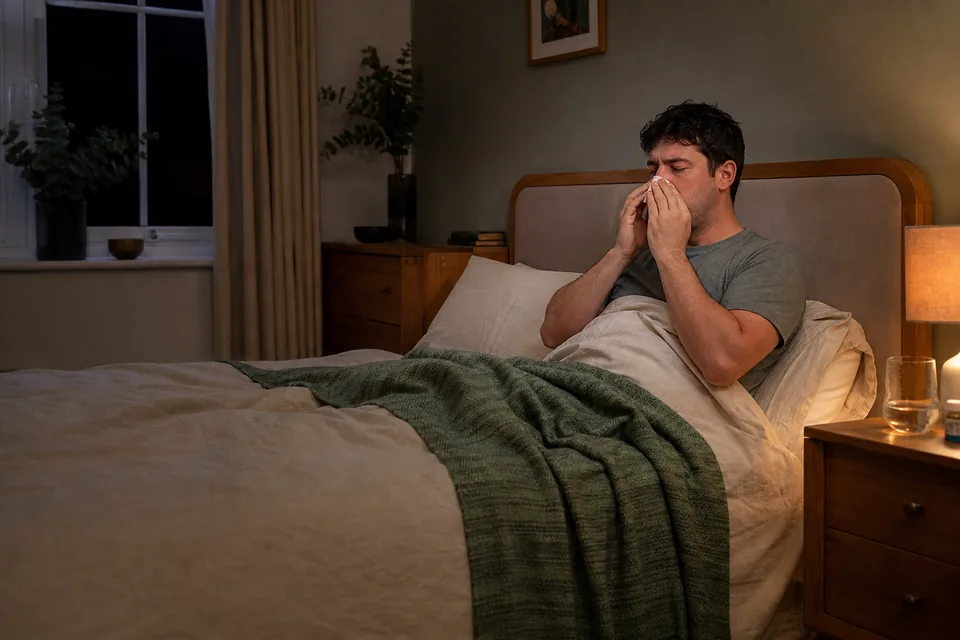
You have come to bed tired, but every breath through your nose feels like work. Perhaps one side is blocked, perhaps both are, and now you are wondering whether to prop yourself up, find a spray or simply breathe through your mouth and hope for sleep.
For a blocked nose that arrived with a short-lived cold, keep tonight simple. Drink enough, sit in a steamy bathroom with a hot shower running if that feels soothing, and ask a pharmacist about medicine if comfort measures are not enough. Check every label before taking anything. Do not combine two treatments for congestion, and do not use nasal sprays containing xylometazoline or oxymetazoline for more than five days.
Ask a more useful question: "Does this look like a brief illness, a repeating trigger or a blockage that needs assessment?" You only need enough relief to rest safely tonight. A symptom that returns night after night needs a different response from another bedtime remedy.
Make tonight easier without chasing a perfectly clear nose
Start with what is happening now. If you can breathe comfortably through your mouth, speak normally and you are dealing with nasal stuffiness rather than true shortness of breath, settle on one or two low-risk comfort measures.
Have some water. If you also have ordinary cold symptoms, rest and fluids are reasonable home care, and a cold should usually begin to improve within one to two weeks. A warm shower may make the blocked feeling easier for a while. Sit in the bathroom with the shower running rather than leaning over a bowl of boiling water. The NHS suggests shower steam for a blocked nose and warns about scalding from bowls of hot water.
You can adjust your pillows if a slightly raised position feels easier, but there is no universal angle or sleeping side that clears every blocked nose. Do not build a precarious stack that strains your neck or makes you less secure in bed. Comfort is the test.
If the blockage eases but you remain awake and frustrated, stop adding nasal remedies. The remaining problem may now be wakefulness, and the calmer steps in what to do when you still cannot fall asleep are more relevant.
Decide whether the pattern looks brief, triggered or persistent
A blocked nose at bedtime can feel like one problem, but the timing around it gives you better clues than the clock alone.
A brief pattern comes with a recent cold and changes over days. A triggered pattern keeps appearing around the same room, season, smell, weather change or exposure. Irritation inside the nose can cause blockage without a cold, and NHS guidance lists weather, humidity, smoke, perfume, alcohol, some medicines and prolonged decongestant-spray use among possible triggers of non-allergic rhinitis.
A persistent pattern has no clear explanation, does not respond to pharmacy treatment or is affecting sleep and everyday life. Those are reasons to speak to a GP rather than continuing to swap bedtime remedies.
Do not use this three-part check to diagnose yourself. A cold, allergy, non-allergic rhinitis, sinus problem or structural obstruction cannot be identified from bedtime timing alone. The check tells you what kind of next step makes sense: simple care for a brief problem, a small trigger investigation for a repeating problem, or clinical advice for a persistent one.
If the blockage seems tied to the room, check one actual bedroom disturbance at a time. Changing bedding, fragrance, ventilation, temperature and cleaning products all at once leaves you unable to tell what mattered.

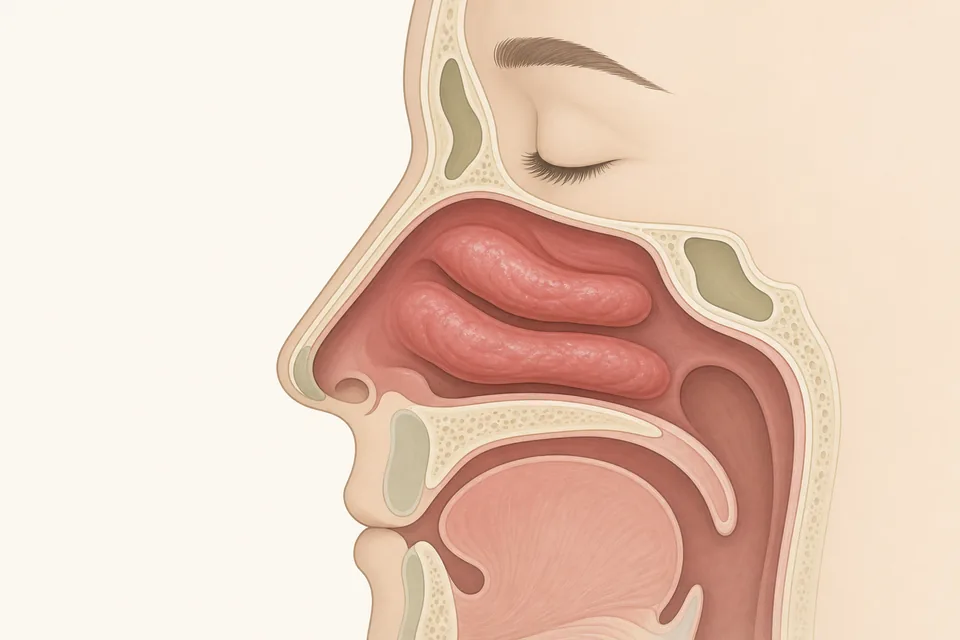
A blocked feeling can come from swelling as well as mucus
You may keep blowing your nose because blockage feels as though something must be stuck there. Sometimes mucus is part of it. Swollen tissue and blood vessels inside the nose can also narrow the space for air.
This explains why a decongestant can make breathing feel easier even when little comes out when you blow your nose. Decongestants reduce swelling in the blood vessels of the nose and can provide short-term relief.
It also explains why repeatedly using more spray can backfire. Relief from swelling is not proof that the original cause has gone, and continued use of certain sprays can create more swelling. If a spray worked at first and the blockage now seems to return sooner or feel worse, check the active ingredient and how many days you have used it.
Do not force nasal breathing or hold your breath to test whether the airway is open. If a breathing exercise feels uncomfortable while your nose is blocked, stop. Our breathing exercise safety guide explains why comfort comes before completing a pattern.
Check the label before you add medicine
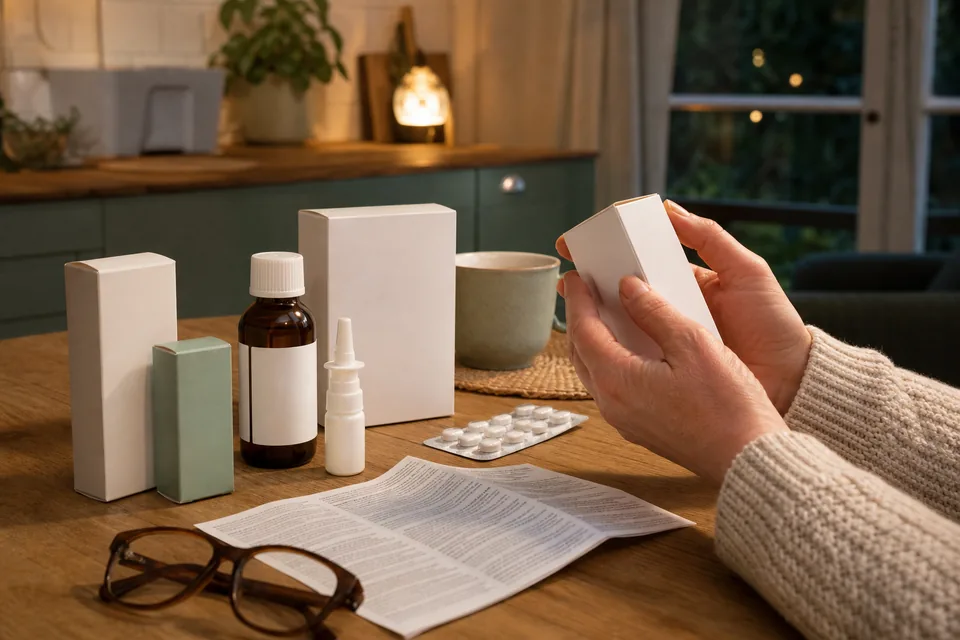
The medicine shelf becomes risky when several products are trying to solve the same symptom. A nasal spray, congestion tablet and all-in-one cold remedy may look like separate options while duplicating treatment or other ingredients.
The NHS says not to use more than one medicine for a blocked nose at the same time. All-in-one decongestants may also contain painkillers or antihistamines, so taking extra doses of those ingredients can be dangerous. Read the active ingredients, not only the brand name. If you are unsure what overlaps, take the packets to a pharmacist.
Ask a pharmacist or GP before using a decongestant if you take other medicines or have a long-term condition. NHS guidance notes that decongestants are not suitable for everyone, including some people with high blood pressure, diabetes, glaucoma, an overactive thyroid, prostate problems, or heart, circulation, kidney or liver conditions. Pregnancy and breastfeeding also need individual advice.
Some decongestants can cause sleepiness, while others can leave a person restless or agitated. Check the leaflet and notice how the medicine affects you. Do not drive, cycle in traffic or operate machinery if you feel drowsy, dizzy or unable to concentrate. Do not stop or change prescribed medicine on the strength of this article. Speak to a pharmacist, GP or the clinician who prescribed it.
This plan is for adults. Children, pregnancy, breastfeeding and care after nasal surgery need advice suited to the person and situation.
The five-day limit may explain why the spray stopped helping
In April 2026, the UK medicines regulator limited nasal sprays and drops containing xylometazoline or oxymetazoline to a maximum of five days. The MHRA warned that excessive use can cause rebound congestion, where swelling caused by overuse adds to the blocked feeling.
Some older packs may still say they can be used for up to seven days because packaging changes take time. The current MHRA advice is five days for those two active ingredients.
This gives you a practical label check tonight:
- Find the active ingredient on the box, bottle or leaflet.
- Count every day you have used it, including days when you used only one dose.
- If it contains xylometazoline or oxymetazoline, do not continue beyond five days.
- If the blockage remains after five days or seems worse, ask a pharmacist or GP what to do next rather than restarting or increasing it.
Rebound congestion can resemble the problem you were trying to treat. That is why the quick relief can appear to fade and why another spray is not automatically the answer.

Treat saline, steam and nasal strips as comfort options
A saline spray or rinse may feel soothing and can be discussed with a pharmacist, but it will not tell you why the blockage keeps returning. Keep the equipment clean and follow the product instructions. If it stings, causes bleeding or makes you feel worse, stop.
Shower steam may ease a blocked nose during a cold, but it is temporary comfort rather than a cure. Avoid bowls or pans of boiling water. Burns are a poor trade for a few minutes of relief.
A nasal strip is another comfort option, not a guaranteed sleep treatment. In two randomised trials involving people with chronic night-time congestion and self-reported sleep impairment, branded nasal strips did not significantly improve subjective sleep outcomes or congestion compared with placebo strips. The studies were industry funded and relied on subjective measures, so they do not settle every question about individual comfort. They do show why feeling a strip pull the nose open should not be turned into a promise of better sleep.
The same limit applies to humidifiers, essential oils and strong vapour products. A dry or irritating room may matter to you, but adding moisture or fragrance without a clear reason can introduce another irritant. Mouth taping is especially unsuitable when nasal breathing is obstructed. Do not seal your mouth to force air through a blocked nose.
Do not mistake nasal blockage for sleep apnoea
A stuffy nose can make bedtime uncomfortable. Sleep apnoea is a different breathing problem in which breathing stops and starts during sleep.
Ask someone who shares the room whether they have noticed pauses in your breathing, followed by gasping, snorting or choking. Also notice whether you are persistently very tired during the day. The NHS advises seeing a GP for these signs. Our guide to the difference between snoring and sleep-apnoea warning signs can help you describe what has been observed.
Relieving nasal resistance should not be presented as treatment for sleep apnoea. A systematic review found that reducing nasal resistance generally did not improve the apnoea-hypopnoea index, the measure used to count breathing events in the included studies. A spray, strip or different pillow must not replace assessment when breathing pauses or choking have been witnessed.
Do not use white noise to cover sounds that may be important. If another person hears repeated gasping or pauses, record what they noticed and take it to a GP rather than masking it.
Driving needs a separate boundary. If marked sleepiness makes it hard to stay awake, do not drive. Arrange another way to travel and seek medical advice about the cause. A clearer nose does not prove that sleepiness is under control.
Map a returning blockage for seven nights
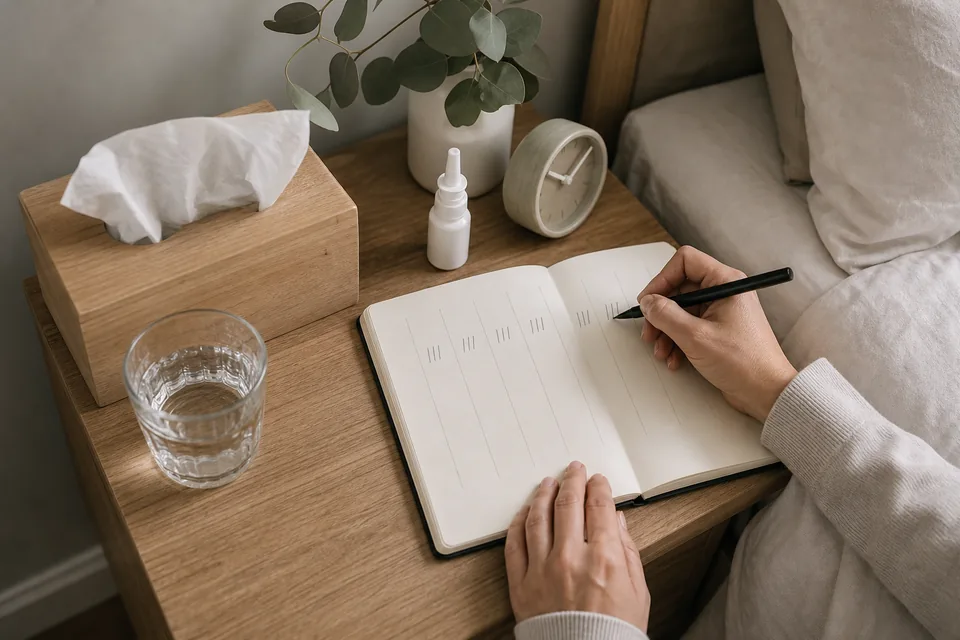
If this is happening repeatedly, you need a short pattern record rather than a larger collection of remedies. Use paper or a note on your phone for up to seven nights.
Before entering the bedroom, mark your nose as clear, partly blocked or very blocked. Check again after you have settled. Note only context that could change the decision: cold symptoms, sneezing or itchy eyes, a room or bedding change, smoke or perfume, alcohol, medicine or spray use, and whether one or both sides felt blocked.
Write down what you tried and whether it improved comfort, made no difference or caused irritation. Change one thing at a time. The next morning, note whether blockage woke you and whether anybody witnessed loud snoring with pauses, gasping or choking.
At the end of the week, look for one repeated clue. Blockage that starts before you enter the bedroom points away from the room itself. Blockage that appears after a particular exposure gives you something specific to discuss or remove. A cold should show a changing timeline. A spray used across several days may reveal the five-day issue. No pattern is also useful information when you speak to a pharmacist or GP.
Keep the record brief. If monitoring makes you anxious or more watchful in bed, stop. You can still tell a clinician how often the blockage occurs, whether it is one-sided or both-sided, what you have tried and how it affects sleep.
If congestion is only one of several causes of broken sleep, use the guide to investigating repeated night waking rather than assuming every awakening came from your nose.
Know when bedtime self-care has reached its limit
Call 999 or go to A&E if you have severe difficulty breathing, are gasping or choking, or cannot get words out. That is not a blocked-nose sleep problem to manage at home. NHS 111 can advise when breathing is more difficult than usual but does not meet that emergency description.
For a cold, seek clinical advice if symptoms get worse, you feel short of breath or have chest pain, or the symptoms have not improved after ten days. Make a GP appointment if nasal symptoms keep affecting sleep and daily life, the cause is unclear or pharmacy treatments have not worked.
Seek a GP assessment for breathing that stops and starts during sleep, gasping, snorting or choking noises, or persistent marked tiredness during the day. Do not diagnose sleep apnoea from snoring or congestion alone.
For tonight, the plan is smaller. Use a simple comfort measure, avoid boiling-water steam, check medicine ingredients and duration, and do not stack treatments. If the blockage keeps returning, map the pattern for a week. If breathing itself is difficult, the symptom is persistent or sleep-related breathing signs appear, move from bedtime self-care to the right NHS service.
Put this guide in context
Choose a next step that matches the problem you actually have. A bedroom that makes rest easier offers a closer look at a connected question. If you are unsure where to begin, use the Start Here selector instead of trying several changes at once.
These suggestions are written for adults and need adapting to your health, responsibilities and living arrangements. A short morning note can help you describe a pattern, but keeping records is optional. You do not need to collect perfect evidence before asking for help. If an experiment makes you more uncomfortable or preoccupied, stop and choose a simpler response.
This is general information, not medical advice. Seek individual guidance for symptoms, treatment decisions or medicine questions. Persistent problems and safety concerns deserve attention even if some parts of an evening routine feel helpful.
Sources & references
Clinical context and further reading. Our practical examples are editorial suggestions, not individual treatment protocols.
- NHS: Common cold
- NHS: Decongestants
- NHS: Non-allergic rhinitis
- MHRA: Recommended use of some nasal decongestant sprays limited to five days
- NHS: Shortness of breath
- NHS: Sleep apnoea
- Sleep Quality and Congestion with Breathe Right Nasal Strips: two randomised controlled trials
- Systematic review: the influence of nasal obstruction on sleep apnoea
Source check: 16 September 2026. Evidence label: NHS and MHRA guidance, randomised trials and a systematic review. Read how we use evidence.