
Sleep problems / Field guide
Why do I wake up to pee at night? Work out what woke you first
Work out whether bladder urgency woke you or you noticed the need to pee after another awakening, then record the pattern safely.

You are awake again, heading to the toilet and wondering whether you drank too much or whether something is wrong. Before you cut down your fluids, notice one detail. Did a strong bladder urge wake you, or did you wake for another reason and decide to pee because you were already up?
Both sequences happen. Night-time urination can begin with urine production or bladder urgency, but pain, worry, noise, insomnia or another sleep disturbance can wake you first. Once awake, you may notice a bladder that was not full enough to wake you on its own.
The other useful clue is how much you pass. One substantial visit, several small urgent visits and frequent urination across the whole day are different patterns. They do not give you a diagnosis, but they can show a GP or continence professional where to start.
Start with what woke you first
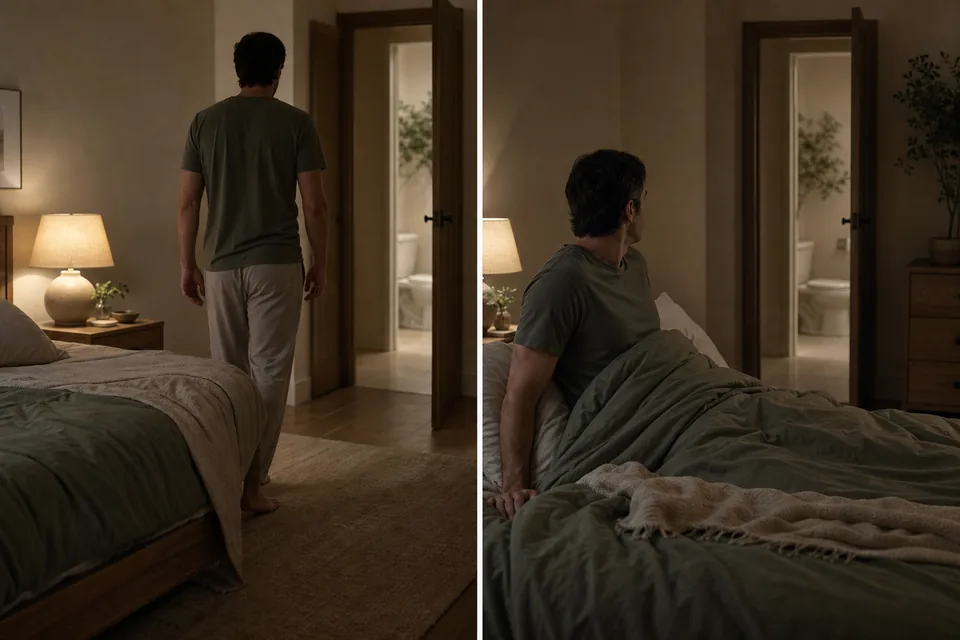
Think back to the few seconds before you got out of bed. Perhaps a strong urge broke through sleep. That is a different starting point from waking with pain, a racing mind, a snore, a hot room or no obvious reason, then deciding you might as well use the toilet.
The distinction is easy to miss because both nights end in the bathroom. Sleep and bladder specialists describe the relationship in both directions: the need to urinate can disturb sleep, and an awakening for another reason can come before the decision to urinate. NHS nocturia guidance also recognises "secondary voiding", where somebody wakes because of anxiety, pain or insomnia and empties the bladder while awake even if it is not full.
You do not need to watch yourself closely enough to make sleep worse. On waking, make a quick mental note: urge first, awake first or unsure. If another disturbance seems to come first, our guide to working through repeated night waking will help you examine that side of the pattern.
Use the amount as a clue, not a verdict
Count alone can be misleading. One or two large amounts may suggest that your body is making a substantial share of its urine at night. Repeated small amounts with a sudden urge raise a different question about bladder storage or irritation. Frequent trips with a weak or interrupted stream, straining or a feeling that you have not emptied fully need another kind of assessment.
NICE says a frequency and volume chart can help a healthcare professional distinguish higher night-time urine production from urgency with frequent small amounts. Its guidance for men with bothersome lower urinary tract symptoms uses at least three days of recorded times and volumes. NICE also recommends a minimum three-day bladder diary when women first present with urinary incontinence, recording fluid intake, urgency, leakage and the amounts passed.
These categories are starting points for assessment. A home record cannot tell you that you have nocturnal polyuria, an overactive bladder, urinary retention, prostate disease or any other condition. Even incomplete emptying and urgency leakage are different urinary patterns, despite both being able to produce frequent bathroom visits.

Separate an all-day pattern from a night-only change
Ask what happens between breakfast and bedtime. Are you also urinating more often during the day? Are the amounts generally large? Have you become persistently thirsty, unusually tired or lost weight without trying?
The NHS lists peeing more than usual, constant thirst, tiredness and unintentional weight loss among common symptoms of type 2 diabetes. Those symptoms have several possible explanations, so they do not diagnose diabetes. If they occur together, arrange a GP appointment instead of trying to manage the problem by restricting fluids.
A pattern that is concentrated at night still has several possible routes. The body may produce more urine overnight, the bladder may hold or empty differently, or broken sleep may make an ordinary bladder sensation noticeable. NHS Devon guidance groups common causes under urine production across the day, increased night-time production, bladder storage and sleep disorders. The point of sorting the pattern is to choose a useful conversation, not to label yourself.
Do not make dehydration the experiment
It is sensible to notice a large drink close to bedtime, especially if this is unusual for you. It is less useful to keep cutting your total intake when you already drink a normal amount or feel thirsty. Guy's and St Thomas' NHS guidance says reducing how much you drink does not help unless you currently drink large amounts.
For three days, record what you normally drink and when. You can then see whether most of it has drifted into the evening without imposing a universal cut-off time. Keep following any fluid plan given by your clinician.
Do not add salt, electrolyte drinks or supplements to try to hold on to water. Do not hold urine through pain. If you take a water tablet or another medicine that could affect urination, keep taking it as prescribed and ask a pharmacist or prescriber whether the timing needs review. NHS guidance says regular medicines should not be stopped without a doctor's advice.

Let urgency, pain and flow change the route
Small urgent trips deserve attention to the symptoms around them. Note burning, pain, cloudy urine, a sudden change in urgency, lower tummy or back pain, fever, shivering or visible blood. The NHS includes these in its urinary tract infection symptom and warning advice.
Contact a pharmacist or GP if you think you may have a UTI. Ask for an urgent GP appointment or use NHS 111 if you have visible blood in your urine, or if the NHS urgent-advice criteria apply to you. Do not wait to complete a sleep diary when you already need medical help.
Tell a GP about a weak or interrupted stream, straining, repeated leakage or a persistent feeling that your bladder has not emptied. These details are more useful than assuming the change is simply age or, for men, the prostate. Oxford Health notes that assessment may include a urinary history, urine testing, a bladder scan and a bladder diary.

Treat breathing signs as a sleep question too
Night-time urination can sit beside a sleep problem. It does not prove sleep apnoea. Look for the wider pattern. NHS warning signs for sleep apnoea include breathing that stops and starts, gasping, snorting or choking, loud snoring, repeated waking and marked tiredness during the day.
Ask a GP for an assessment if those signs fit, especially if someone has witnessed pauses in your breathing. Our guide to snoring and sleep-apnoea warning signs can help you describe what has been observed. If you feel too sleepy to drive safely, do not drive. Arrange another way to travel and seek medical advice.
You may remain persistently sleepy or unrefreshed while the urinary pattern is being assessed. The distinctions in why you still feel tired after sleep can help you describe the daytime effect without assuming that every symptom has one cause.
Run a three-day wake-or-wee record
Choose three fairly typical days and nights. A note on your phone or a sheet of paper is enough. Record:
- when and roughly how much you drink
- when you go to bed and get up
- the time of every toilet visit
- the amount passed, measured in millilitres with a dedicated jug if that is practical and hygienic, or marked small, medium or large if it is not
- for each night-time visit, whether you noticed urge first, another awakening first or you were unsure
- any daytime urgency, leakage, weak stream, interrupted flow or incomplete-emptying feeling
- any burning, pain, blood, unusual thirst, ankle swelling, loud snoring, breathing pauses, gasping or marked daytime tiredness
Do not stay awake trying to catch the exact sequence. Keep your usual prescribed care unchanged and do not deliberately dehydrate yourself for the record.
After three days, look for a repeated shape rather than calculating a diagnosis. Are the amounts substantial mainly at night? Are they small and urgent? Does frequency continue all day? Does another awakening usually happen first? Frequency and volume records add useful information to a clinical history, but healthcare professionals use them alongside your symptoms and, when needed, tests.

Take the record to the person who can act on it
A pharmacist can help when you suspect a UTI, want to check whether a medicine may affect urination, or need to know which service to use. Keep taking prescribed medicine unless the prescriber tells you to change it.
Arrange a GP appointment when the pattern is new, frequent, distressing, repeatedly breaks your sleep or affects your daytime functioning. Go sooner when you also have persistent thirst, unexplained weight loss, a weak stream, trouble emptying your bladder or new leakage.
Witnessed breathing pauses or marked daytime tiredness also need GP assessment.
Use urgent GP or NHS 111 advice for visible blood in your urine or relevant urgent UTI symptoms. Call 999 for a life-threatening emergency.
The three-day record turns "I keep waking to pee" into a sequence your clinician can use. It shows what woke you, when it happened, how much you passed and what else was going on. That is enough for the home investigation. The cause belongs in a proper assessment.
Put this guide in context
Choose a next step that matches the problem you actually have. Waking up at night offers a closer look at a connected question. If you are unsure where to begin, use the Start Here selector instead of trying several changes at once.
These suggestions are written for adults and need adapting to your health, responsibilities and living arrangements. A short morning note can help you describe a pattern, but keeping records is optional. You do not need to collect perfect evidence before asking for help. If an experiment makes you more uncomfortable or preoccupied, stop and choose a simpler response.
This is general information, not medical advice. Seek individual guidance for symptoms, treatment decisions or medicine questions. Persistent problems and safety concerns deserve attention even if some parts of an evening routine feel helpful.
Sources & references
Clinical context and further reading. Our practical examples are editorial suggestions, not individual treatment protocols.
- Oxford Health NHS: Understanding nocturia
- NICE: Urinary frequency and volume chart
- NICE: Bladder diaries and lifestyle changes
- Impact of nocturia on sleep and quality of life
- NHS: Urinary tract infections
- NHS: Symptoms of type 2 diabetes
- NHS: Sleep apnoea
- NHS: Urinary incontinence
- Guy's and St Thomas' NHS: Nocturia, getting up at night to pee
- NHS Devon: Nocturia referral guidance
Source check: 18 September 2026. Evidence label: NHS and NICE guidance with a peer-reviewed sleep review. Read how we use evidence.