
Sleep problems
Are Sleep Trackers Accurate? What Your Watch Can and Can’t Tell You
Sleep trackers can be useful without being right about everything. Learn which numbers deserve caution, what patterns are useful and when symptoms matter more than a score.
Checked against NHS and other linked sources on 3 October 2026. Not reviewed by a doctor. How guides are made
The short answer
Sleep trackers can be useful for spotting broad patterns in your sleep, particularly when you look at trends over several nights or weeks. But they do not measure sleep in the same way as a clinical sleep study, and estimates of deep sleep, REM sleep, waking and sleep quality should not be treated as exact.
If your watch says you slept badly but you feel well, the watch does not automatically overrule how you feel. Equally, a reassuring sleep score should not stop you seeking advice if you regularly struggle with sleep, feel excessively sleepy during the day, or have symptoms such as loud snoring, gasping or pauses in breathing.
Think of your sleep tracker as a **trend-spotting tool rather than a nightly sleep exam**.
This guide is general information, not medical advice. If you are worried about your symptoms, speak to a GP or pharmacist.
You wake up feeling reasonably refreshed, reach for your phone and discover that your sleep tracker has other ideas.
Your sleep score is 62. Apparently, you spent too little time in deep sleep, woke up seven times and had less REM sleep than usual.
Suddenly, a morning that felt perfectly normal starts to feel like the aftermath of a bad night's sleep.
Sleep trackers can provide genuinely useful information. But the numbers on your wrist are still estimates, and some measurements are considerably more dependable than others.
Understanding that difference can make your tracker much more useful, and much less likely to become something you worry about.
How does a sleep tracker know you're asleep?
Your watch or ring cannot see directly whether your brain is asleep.
Instead, consumer wearables typically use signals such as movement and heart-related measurements, sometimes alongside other sensor data. Their algorithms then estimate when you were awake, when you were asleep and, on many devices, which stage of sleep you were probably experiencing.
That distinction matters.
In a clinical sleep study, known as polysomnography, sensors can record brain activity, eye movements and muscle activity, as well as measurements such as breathing, heart rate and blood oxygen. Brain and eye activity are important parts of identifying sleep stages.
Your smartwatch does not have the same information available to it.
It is making an informed estimate from a much smaller set of signals.
That doesn't make the information useless. It simply means it needs to be interpreted differently.
So how accurate are sleep trackers?
There isn't one percentage that tells us how accurate sleep trackers are.
Accuracy depends on the device, its algorithm, the person wearing it and, importantly, what is being measured.
A 2025 meta-analysis compared consumer wrist-worn sleep trackers with polysomnography, the standard laboratory method used for detailed sleep assessment.
Across 24 studies involving 798 participants, the researchers found significant differences between consumer trackers and polysomnography for measures including total sleep time, sleep efficiency, the time taken to fall asleep and time awake after initially falling asleep.
The researchers concluded that consumer trackers were not as reliable as polysomnography for these key measurements, although they could still be useful for tracking general sleep patterns.
A more recent systematic review reached a similar conclusion. Wearables could provide reasonable estimates of broad sleep measures and could be useful for long-term self-tracking, but performance varied considerably between devices and measurements.
That gives us a much more useful way of looking at sleep-tracker accuracy.
Instead of asking:
“Is my sleep tracker accurate?”
ask:
“What is this particular number good enough to tell me?”
Why can my watch think I'm asleep when I'm actually awake?
This is one of the most common reasons people begin questioning their sleep tracker.
You might remember lying in bed awake for quite some time, yet your tracker records most of that period as sleep.
There is a good reason this can happen.
Consumer wearables tend to be better at recognising sleep than recognising wakefulness when someone is lying relatively still.
In a 2025 laboratory study comparing six commercial wrist-worn devices with polysomnography, all six detected more than 90% of sleep periods. Their ability to correctly identify wakefulness was substantially lower.
Imagine lying quietly in bed at 3am.
You are awake, but you're barely moving. Your heart rate may also be relatively low.
From the limited signals available to a wearable device, that can look remarkably similar to sleep.
So if you clearly remember being awake but your tracker insists you were asleep, your memory and the tracker aren't necessarily describing the same thing incorrectly. The device may simply have had insufficient information to distinguish quiet wakefulness from sleep.
This is particularly worth remembering if you already wake frequently during the night.
Can you trust the deep sleep and REM numbers?
This is where I would be particularly cautious about taking individual numbers literally.
Sleep stages are defined using physiological signals that include brain activity and eye movements. A laboratory sleep study can measure these signals directly.
A watch or ring generally cannot.
Instead, its software estimates which sleep stage you were probably in from the signals its sensors can collect.
Modern devices are becoming increasingly sophisticated, and validation studies show that some can identify sleep stages reasonably well under certain conditions. But results still vary between devices, sleep stages and individuals.
A 2025 comparison of six commercial wearables found only fair to moderate overall agreement with polysomnography for sleep-stage classification.
Another recent systematic review found that no wearable demonstrated consistently superior performance across sleep measurements.
So if your tracker says:
Deep sleep: 54 minutes
it is better to interpret that as an estimate produced by the device's algorithm than as proof that your brain spent precisely 54 minutes in deep sleep.
The same applies to REM sleep.
This becomes especially important when people start trying to “fix” a particular sleep stage because their wearable says they aren't getting enough of it.
A single low deep-sleep or REM reading is not a diagnosis.
What about my sleep score?
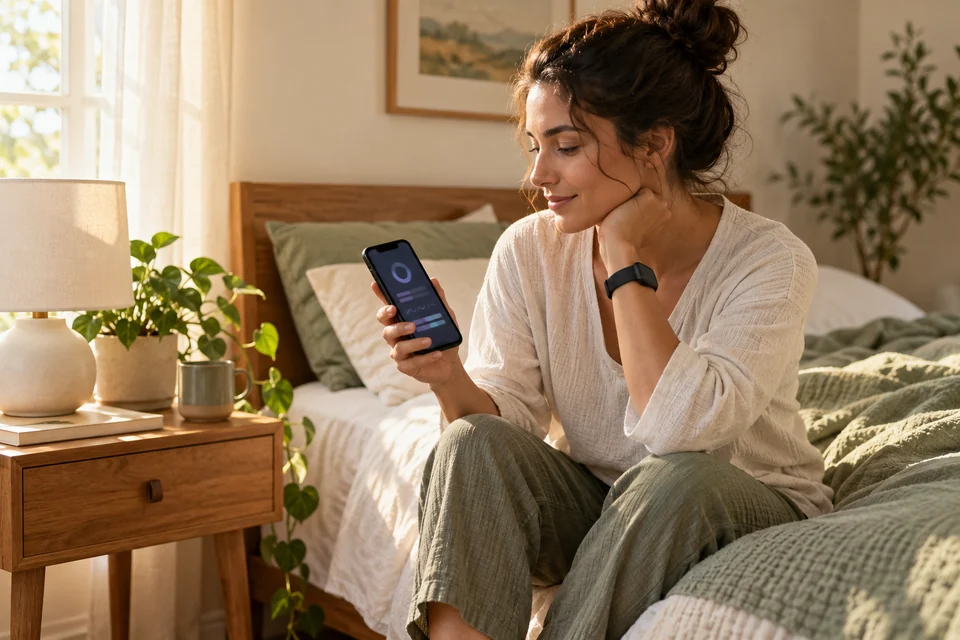
Sleep scores are useful because they turn a complicated collection of measurements into one simple number.
They're also easy to misunderstand.
Your sleep score is not a universal medical measurement.
It is a calculation created by the company behind your device using its own combination of measurements and algorithms.
That means a score of 80 on one platform does not necessarily mean exactly the same thing as 80 on another.
More importantly, your sleep score cannot completely describe how restorative your sleep was or how you will function during the day.
A 2026 systematic review looking at commercial wearable measurements and people's reported sleep quality found poor to moderate agreement overall. The researchers concluded that wearable information should complement rather than replace people's own assessments of their sleep.
That gives you permission to use some common sense.
If your tracker gives you a disappointing score after one night but you feel alert, rested and capable of getting on with your day, you do not need to manufacture a sleep problem because an app has given you an orange number.
What are sleep trackers actually good for?
Their greatest strength may be patterns rather than precision.
One night can be noisy data.
Several weeks can tell a more useful story.
Suppose you notice that your estimated sleep duration regularly drops on evenings when you stay up later. Or your sleep schedule becomes much more irregular at weekends. Perhaps your tracker shows that you consistently spend less time in bed than you thought.
Those patterns can give you something useful to investigate.
You might use your tracker to explore questions such as:
- Am I giving myself enough opportunity to sleep?
- Is my bedtime becoming increasingly irregular?
- Do I tend to sleep differently after late caffeine or alcohol?
- Does travel or shift work disrupt my normal pattern?
- Did a change to my routine appear to make a difference over several weeks?
The important word is pattern.
Try not to turn normal night-to-night variation into a nightly performance review.
If you're unsure how much sleep to aim for in the first place, our guide to how much sleep adults need explains why eight hours isn't a magic target.
Why does my tracker give different results from another device?
Two sleep trackers can observe the same person on the same night and produce different results.
That isn't as strange as it sounds.
Devices can use different sensors, different combinations of signals and, crucially, different proprietary algorithms to translate those signals into sleep and sleep-stage estimates.
Algorithms also change.
A software update may alter how a device interprets your sleep without anything changing about the way you actually sleep.
This is another reason I wouldn't spend too much time comparing your exact percentage of deep sleep with a friend wearing a different device.
Even switching from one tracker to another can create an apparent change that partly reflects the technology rather than your body.
For long-term tracking, consistency may therefore be more useful than constantly changing devices in search of the “correct” number.
Should you worry about one bad night's data?
Usually, no.
Sleep naturally varies from night to night.
Your routine changes. You may go to bed later, wake briefly, feel warmer than usual, have a stressful day or simply experience a different pattern of sleep.
Your tracker adds another source of variation because its measurements are estimates.
Put those two things together and chasing individual nightly numbers can quickly become frustrating.
If you want to use a tracker constructively, zoom out.
Look at several nights or weeks rather than treating Tuesday night's sleep score as a verdict on your health.
The same principle applies when you've genuinely had a rough night. If you're wondering what to do the following day, our guide to napping after a bad night's sleep can help you decide whether a nap is likely to help or make the following night harder.
Can tracking your sleep make sleep anxiety worse?
For some people, sleep data is reassuring.
For others, it becomes another thing to get right.
You may recognise the pattern:
You check your sleep score immediately after waking.
A low score bothers you.
You examine the graphs.
You start calculating how much deep sleep you need tonight to make up for yesterday.
By bedtime, you're thinking about whether you're going to achieve a better result.
Researchers have used the term orthosomnia to describe an unhealthy preoccupation with achieving ideal sleep data from tracking devices.
That doesn't mean using a wearable will automatically make you anxious about sleep.
A small 2023 study involving people with insomnia did not find that wearing a sleep tracker necessarily increased sleep-related worry compared with keeping a handwritten sleep diary.
But if tracking makes you more preoccupied with sleep rather than better informed about it, that's worth noticing.
Try hiding the data for a few days or taking the device off at night.
Your tracker is supposed to give you information.
You don't owe it a better score.
Your watch says you slept badly, but you feel fine
This is probably the easiest situation to deal with.
Get on with your day.
Your device has estimated your sleep from sensor data. You have additional information available to you that the device does not: how you actually feel and function.
Ask yourself:
Do I feel reasonably alert?
Can I concentrate?
Am I unusually sleepy?
Does this feel different from my normal morning?
If you feel fine and the poor score is an isolated result, there is little value in allowing the number alone to dictate how you expect to feel.
Over time, however, repeated patterns can still be useful. If your tracker consistently suggests very short sleep and you also begin feeling tired during the day, the combination is more informative than either observation alone.
Your watch says you slept brilliantly, but you feel exhausted
This deserves a different response.
Don't dismiss persistent symptoms simply because your tracker gives you reassuring numbers.
A consumer sleep tracker is not designed to rule out a sleep disorder.
The American Academy of Sleep Medicine has specifically cautioned that consumer sleep technology should not replace appropriate medical evaluation or validated diagnostic testing.
For example, if you regularly feel very tired during the day and also have loud snoring, gasping, choking or witnessed pauses in breathing during sleep, those can be symptoms of sleep apnoea.
A high sleep score doesn't cancel those symptoms.
Can a sleep tracker diagnose insomnia or sleep apnoea?
A standard consumer sleep tracker should not be treated as a stand-alone diagnostic test.
It may notice patterns that encourage you to investigate further, and some devices have particular regulated health features. But that is different from assuming the general sleep dashboard can diagnose why you're sleeping badly.
Clinical sleep assessment uses your symptoms, medical history and, when appropriate, validated testing.
A full sleep study can record information such as brain waves, breathing, oxygen levels, eye movements, heart rate and muscle activity.
Your wearable may contribute useful information to a conversation with a healthcare professional, particularly if you've collected data over time.
But the tracker should support that conversation rather than replace it.
A simple way to use your sleep tracker without obsessing over it
You don't have to stop tracking your sleep.
Just change what you expect from the tracker.
Look for trends. A week or month is generally more informative than a single night.
Prioritise the basics. Bedtime, wake time and approximate sleep duration are often easier to interpret than minute-by-minute sleep-stage graphs.
Compare yourself with yourself. Your own longer-term pattern is usually more useful than comparing your score with someone else's.
Notice how you feel. Energy, alertness and daytime sleepiness are information too.
Don't chase individual sleep stages. Your REM and deep-sleep numbers are estimates, not targets you need to hit every night.
Take a break if tracking creates pressure. There is no requirement to measure sleep in order to sleep well.
This also fits with the broader approach we take at Rested Review: make useful changes where there is a genuine problem, rather than trying to engineer a perfect night.
When is it worth speaking to your GP?
The numbers on your tracker are less important than persistent symptoms.
The NHS advises speaking to a GP if you've had trouble sleeping for months, changes to your sleep habits haven't helped, or insomnia is affecting your daily life in a way that makes it difficult to cope.
You should also seek medical advice if you have symptoms suggesting sleep apnoea, particularly breathing that stops and starts during sleep, gasping or choking noises, or persistent excessive tiredness during the day.
If you have tracker data, you can take it with you.
Just describe what you've actually been experiencing as well.
“I've been exhausted every afternoon for three months” is important information even if your watch keeps congratulating you on your sleep.
The number is a clue, not a verdict
Sleep trackers have become remarkably good at collecting information from something small enough to wear on your wrist or finger.
That makes them interesting and potentially useful.
But useful doesn't mean infallible.
The best relationship with a sleep tracker is probably somewhere between ignoring it completely and believing every number it produces.
Use it to notice patterns.
Use it to become curious about your routine.
Use it to see whether changes seem to persist over time.
Then put the numbers alongside the piece of sleep technology that knows more about how you feel than any wearable currently does:
you.
Sources & references
The health information in this guide is based on these sources. Links open in a new tab.
- Lee YJ, Lee JY, Cho JH, Kang YJ, Choi JH. Performance of consumer wrist-worn sleep tracking devices compared to polysomnography: a meta-analysis. J Clin Sleep Med. 2025;21(3):573-582.
- Schyvens A-M, Peters B, Van Oost NC, et al. A performance validation of six commercial wrist-worn wearable sleep-tracking devices for sleep stage scoring compared to polysomnography. Sleep Advances. 2025;6(2):zpaf021.
- Agostinho M, Borges M, Pereira T, Borges DF, Soares JI. Are Wearable Sleep-Tracking Devices Reliable Alternatives to Polysomnography? A Systematic Review and Meta-Analysis. Behav Sleep Med. 2026.
- Srivali N, Cheungpasitporn W. Concordance of wearable device sleep metrics with patient-reported sleep quality: A systematic review. Sleep Med. 2026;144:108941.
- Ojalvo D, Pekkola Pacheco A, Benedict C. A useful tool or a new challenge? Hand-wrist-worn sleep trackers in patients with insomnia. J Sleep Res. 2023;32(5):e13883.
- American Academy of Sleep Medicine. Consumer Sleep Technology: An American Academy of Sleep Medicine Position Statement.
- National Heart, Lung, and Blood Institute. Sleep Studies.
- National Heart, Lung, and Blood Institute. How Sleep Works: Sleep Phases and Stages.
- NHS: Insomnia
- NHS. Sleep apnoea.
Sources last checked: 3 October 2026. Read how we use evidence.