
Sleep problems
Why do I twitch as I’m falling asleep? Hypnic jerks explained
A sudden twitch as you drift off can be startling. Learn what sleep starts are, what remains uncertain and when repeated movements need assessment.
Checked against NHS and other linked sources on 1 October 2026. Not reviewed by a doctor. How guides are made
The short answer
A sudden twitch, jolt or falling sensation just as you drift off is often called a hypnic jerk, sleep start or hypnagogic jerk. It happens around the transition from wakefulness to sleep, and the reason is not fully understood. An occasional brief jerk differs from repeated movements through the night or jerks while fully awake. If movements are frequent, continuous, cause injury or come with other unusual symptoms, ask a GP for advice.
This guide is general information, not medical advice. If you are worried about your symptoms, speak to a GP or pharmacist.

You are nearly asleep when your leg kicks, your shoulder jumps or your whole body seems to jolt. Sometimes there is a brief sensation of falling, as if you have missed a step. The movement may wake you just enough to notice it, then the moment passes.
A sudden movement at the boundary between being awake and falling asleep is commonly called a hypnic jerk or sleep start. It may involve the whole body or just one part. The NHS Borders clinical guide describes a sudden jump at the wake-sleep transition. Royal Papworth Hospital also calls sleep starts common when someone is falling asleep.
The key clue is not how dramatic the jolt felt. It is when it happened. One quick movement as you drift off is one pattern. Repeated jerking through the night is another. Movements while fully awake, confusion or injury also change the question. That timing distinction can help you explain what happened, but it cannot diagnose the cause by itself.
A sleep start can interrupt the moment you were hoping to drift off. It does not mean you have failed to relax, and it does not prove that something is wrong with your sleep. If it happens occasionally and you feel otherwise well, you may not need to do anything about it.
Why does my body jerk just as I’m drifting off?
The honest answer is that the exact reason is not clear. NHS Borders says it is not entirely clear why hypnic jerks occur. It mentions one proposed explanation: the brain might mistake muscle relaxation for falling and trigger a movement. This is a suggestion, not a confirmed cause for every episode.
That uncertainty matters. Online explanations can make a sleep start sound like a precise alarm from the brain, a sign of a deficiency or proof that your body is short of oxygen. The authoritative sources reviewed for this guide do not establish those claims. A familiar falling sensation may accompany a sleep start, but the sensation does not reveal a hidden medical cause on its own.
The timing is more useful than guessing at a cause. You could say, “I had one sudden jerk as I was dropping off,” or, “I keep seeing movements after I have been asleep for a while.” These accounts raise different questions for a clinician. You do not need to work out the sleep stage or label the episode before asking for help.
Is a falling sensation part of a hypnic jerk?
It can be. NHS Borders describes people noticing a “jolt” or “sudden falling” feeling. Royal Papworth notes that a sleep start can be accompanied by a falling sensation and, occasionally, a sound or flash of light. These sensations can feel vivid, especially when the movement wakes you, but vividness alone does not tell you what caused it.
You may remember only the sensation and not the instant your body moved. Another person may see a leg kick while you remember a falling feeling. Either way, write down what you actually noticed rather than trying to make the details fit a particular explanation. If there was a sound or image, you can mention it. These experiences are not a reason to assume that a presence was in the room or that a specific condition is present.
A very brief sensation near sleep onset is different from seeing or hearing things repeatedly when fully awake. If unusual perceptions continue outside the transition into sleep, worry you, or interfere with daily life, talk to a GP. This article cannot assess their cause.

What might make sleep starts more noticeable?
People often look for one thing they did wrong the day a twitch happened. A single night rarely answers that question. NHS Borders says jerks may occur more frequently when people are overtired or in an uncomfortable position. Royal Papworth says sleep starts may be worsened by sleep deprivation, stress or caffeine-containing drinks. These are possible associations in the guidance, not proof that any one factor caused your episode.
Use that distinction before changing your routine. If you have had several short nights, you can notice that fact without deciding it explains every movement. If your bedding is uncomfortable, adjust it because comfort matters, not because a particular position is a guaranteed prevention method. If you had caffeine later than usual, note it as context rather than treating one night as an experiment that proves cause and effect.
The NHS lists caffeine, alcohol, stress, noise, an uncomfortable room and shift work among factors that can contribute to insomnia. That broader guidance is about sleep difficulty, not proof that these factors cause an individual hypnic jerk. Keep the two questions separate: what may be affecting your overall sleep, and what pattern did the movement itself follow?
There is no need to cut out every enjoyable activity, buy a supplement or follow an exact bedtime ritual after one sleep start. If an ordinary adjustment makes your evenings more comfortable, it may be reasonable to try it. But do not make a promise to yourself that the jerk must disappear before you can sleep. That can turn a brief, unsettling moment into a nightly test.
If you are curious about a possible pattern, keep the question narrow. For example, you might notice whether a twitch appears only on evenings when you have slept less than usual. That is different from deliberately losing sleep to see what happens. Do not set up a test that leaves you more tired, unsafe or anxious. A few ordinary nights are not a controlled experiment, and a change in frequency does not prove what caused it.
Comfort is a sensible goal in its own right. A pillow or mattress that leaves you uncomfortable can make it harder to settle, whether or not you have sleep starts. Make a practical change if it improves comfort, then let the question of the jerk remain uncertain unless the pattern gives you a reason to seek advice. Sleep does not need to become a project in which every evening is scored.
What should I do when it happens?
If the movement was brief and you feel back to normal, pause and get comfortable. You might take a moment to notice that you were just drifting off and that the jolt has passed. You do not have to count your breaths, hold them, move a particular finger or repeat a phrase until sleep arrives. The sources do not establish a reliable trick that stops every sleep start.
If you are still sleepy, let yourself settle again in the way that feels comfortable. If alert or frustrated, use a low-pressure approach to wakefulness. Choose a quiet activity, avoid checking the time repeatedly and return to bed when you feel sleepy. If getting up is unsafe or difficult for you, do not force it. The guide to difficulty falling asleep covers what to do when the main problem becomes lying awake.
If you share a bed and the movement startled your partner, a simple explanation may help: you noticed a quick jerk as you were falling asleep. You do not need to ask someone to restrain you, wake you repeatedly or monitor every night because of one brief sleep start. If another person has seen repeated movements or behaviour you cannot recall, their plain description of what happened can be useful to bring to a GP.

How is a sleep start different from restless legs?
A brief jerk as you drift off is not the same description as an uncomfortable urge to move that appears while you are resting. Restless legs can involve an urge or unpleasant feeling that worsens at rest and eases with movement. Our restless legs guide explains the pattern.
The practical difference is the sequence. Did one sudden movement happen as you were dropping off? Or did an uncomfortable feeling keep returning while you were awake and still, so you needed to move your legs? These descriptions can overlap in everyday language, and there can be more than one reason for a poor night. A reader cannot diagnose either condition from a checklist. If the pattern repeats or is disturbing your sleep, tell a GP what happens and when.
Repeated kicking noticed by someone else after you have fallen asleep is also not automatically restless legs. The NHS Borders guidance says continuous jerks at night need further assessment. A clinician may need a careful account of the event rather than a label chosen from a search result.

When should I speak to a GP about twitching at night?
Ask a GP if frequent jerks trouble you, happen while you are clearly awake or continue through the night. Seek advice if they cause injury or come with other changes that worry you. NHS Borders specifically advises further assessment for lots of jerks during normal wakefulness or movements happening continuously at night. These are reasons to describe the pattern, not a way to diagnose yourself.
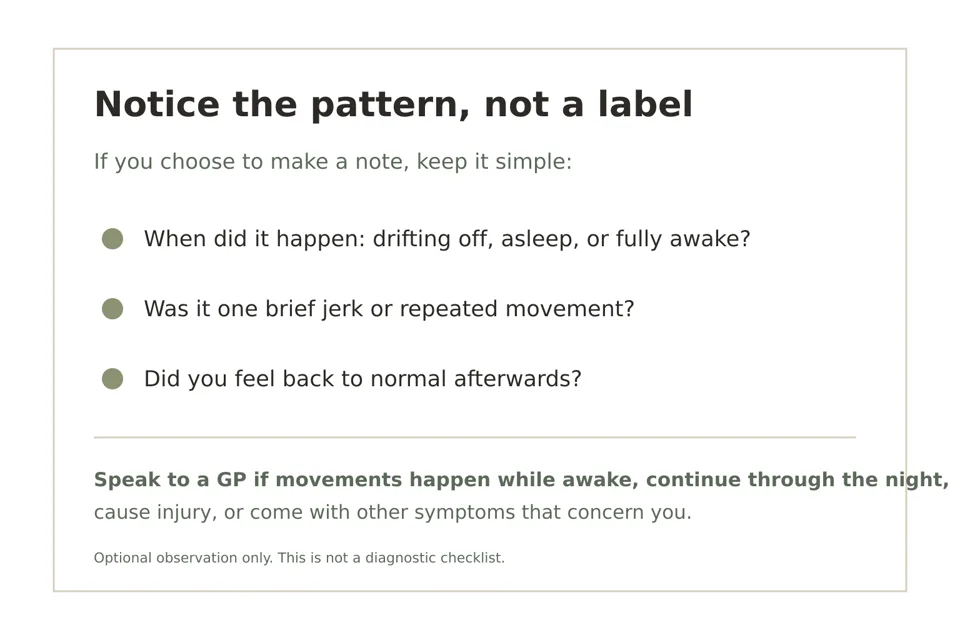
In the morning, note when it happened and whether you were falling asleep or already asleep. Record which part moved, whether it happened once or repeatedly, and how you felt afterwards. If someone else witnessed it, ask them to describe only what they saw. Do not stay awake waiting for another episode, provoke one or use a strict sleep tracker to try to capture it. A short note is optional and should not delay care.
If you lost awareness, had repeated jerking, felt confused afterwards or were injured, do not assume it was a routine sleep start. Seek medical advice. The NHS says to get urgent medical help for a first suspected seizure. Call 999 if it is someone’s first seizure, lasts over five minutes or longer than usual, or if they do not recover as usual before another seizure. Follow the person’s existing care plan if they have one. A brief sleep-onset twitch by itself is not enough to conclude that someone has epilepsy.
Cuellar, Whisenant and Stanton’s peer-reviewed scoping literature review covers hypnic jerks and the available literature. It is a review of the evidence, not proof that a proposed mechanism or trigger applies to an individual. Read the PubMed record for the review.
If poor sleep lasts for months, changes have not helped or daily life becomes hard to manage, the NHS advises seeing a GP about insomnia. You do not have to wait for twitching to become severe before asking about a persistent sleep problem. If you are sleepy, do not drive or do safety-critical work when you cannot do it safely.
If a short reminder helps, use this optional checklist. It is not a way to diagnose yourself.
What can I keep in mind tonight?
A sudden jolt or falling feeling at the moment you drift off can be a sleep start. Its exact cause is not fully understood, and an occasional brief episode does not automatically mean that something is wrong. Note when it happened, whether it was single or repeated, and if you felt back to normal afterwards.
A note may help if a pattern recurs, but you do not need to watch for it or rearrange your evenings. Seek advice if movements happen while awake, continue through sleep, cause injury or leave you confused or unwell. If falling asleep becomes the main problem, use the wider sleep-onset guide or speak to a GP.
Sources & references
The health information in this guide is based on these sources. Links open in a new tab.
- NHS Borders: Hypnic jerk
- Royal Papworth Hospital: Odd behaviour at night (Parasomnia)
- NHS: Insomnia
- NHS: Epilepsy
- The Sleep Charity: Hypnic Jerks
- Cuellar NG, Whisenant D, Stanton MP. Hypnic Jerks: A Scoping Literature Review. Sleep Medicine Clinics. 2015;10(3):393–401.
Sources last checked: 1 October 2026. Read how we use evidence.