
Sleep problems / Field guide
Why do my legs feel restless when I try to sleep?
A practical pattern check for an urge to move at bedtime, including what movement changes and when to seek advice.
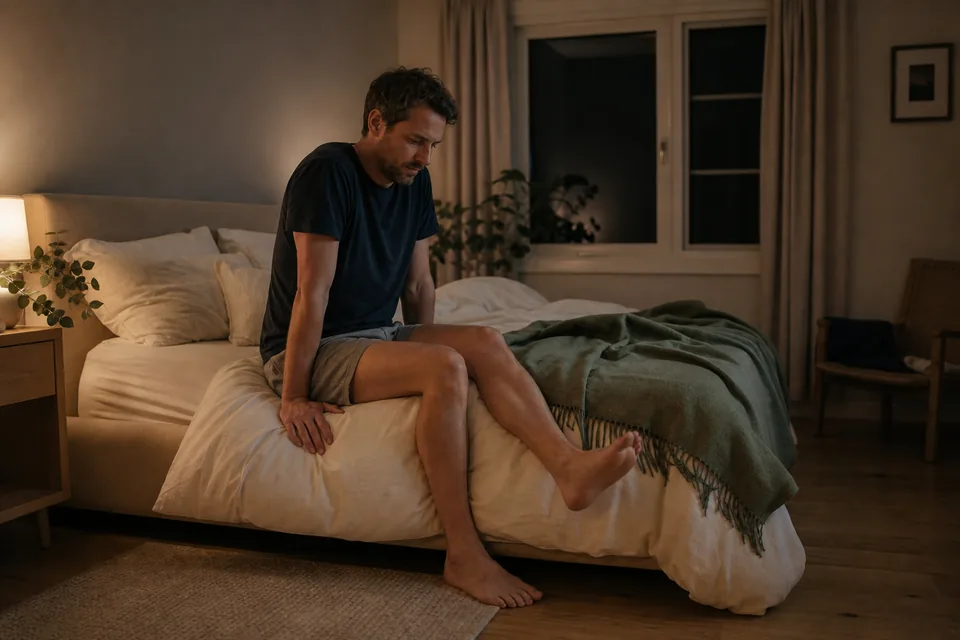
You lie down, your legs start to feel wrong, and staying still becomes harder than getting up again. The feeling might be crawling, tingling, aching or simply an almost irresistible need to move. Walking around may settle it, only for it to return when you get back into bed.
That pattern can fit restless legs syndrome, but the sensation alone does not identify it. Notice whether the urge begins or gets worse while you are resting and eases while you move. Also ask whether it is more noticeable in the evening or at night. A painful muscle knot, numbness, swelling, an injury or kicking noticed only after you fall asleep raises a different question.
If this repeatedly stops you sleeping, speak to a GP. A clinician can review the pattern, your medicines and whether tests for possible contributors are appropriate. Do not start iron or magnesium to see whether it works, and do not stop a medicine on your own.
Ask what movement does to the feeling
Words such as "crawling", "buzzing" and "aching" can help you describe the experience, but they do not settle what it is. Start with a simpler question: what changes when you move?
A restless legs pattern has four linked features. There is an urge to move, often with an unpleasant sensation. It starts or becomes worse during rest, such as sitting or lying down. Walking or stretching brings partial or complete relief while the movement continues. The pattern occurs only in the evening or at night, or is worse then than during the day.
This explains a frustrating part of the experience. If walking helps immediately but the feeling returns when you lie down, you have not failed to stretch properly. Temporary relief during movement is part of the pattern clinicians ask about. It is a clue, not a home test that proves a diagnosis.
Restless legs syndrome is diagnosed from the clinical picture because there is no single test that confirms it. That is why the timing and response to movement are more informative than finding the perfect adjective for the feeling.
A cramp, a twitch and an urge to move are different starting points
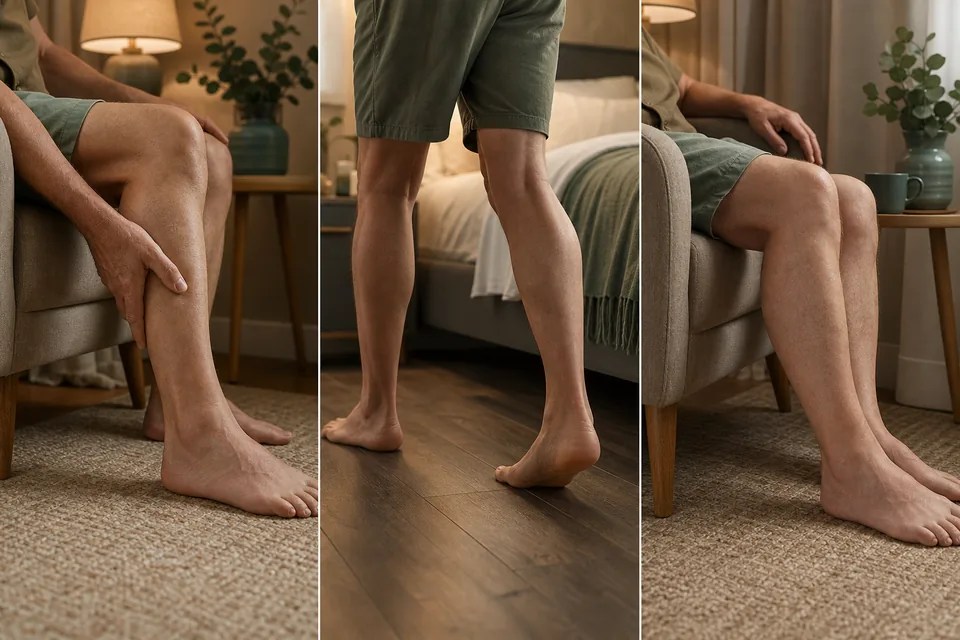
A cramp usually announces itself as a muscle tightening with sudden pain, sometimes making the leg hard to move. That differs from an inner urge that appears during stillness and improves when you walk. The muscle can remain sore for up to 24 hours after a cramp.
Visible twitching is another description rather than a diagnosis. If you are awake when it happens, note whether there is also an urge to move and whether walking changes it. If a partner notices kicking after you are asleep, but you do not experience the awake urge, do not assume that this is restless legs syndrome. Persistent unexplained movements during sleep still deserve discussion with a GP, but they answer a different clinical question. A brief jolt as you drift off is another pattern; our guide to twitches as you fall asleep explains it.
Numbness, new weakness, injury or severe pain should not be squeezed into a restless legs checklist. Seek clinical advice rather than trying another bedtime remedy. The NHS advises seeing a GP when leg cramps disturb sleep or occur with numbness or swelling. Pain and swelling in one leg can be signs of deep vein thrombosis, which needs an urgent GP appointment or NHS 111. Call 999 or go to A&E if the pain and swelling come with breathlessness or chest pain.

Check what changed before blaming your bedtime routine
When the feeling begins suddenly or becomes much worse, look beyond the bedroom. Write down any new medicine, dose change or over-the-counter product, along with when the symptoms began. Some medicines can make restless legs symptoms worse, and an NHS assessment may include a review of what you take.
Take the packets or an accurate list to a pharmacist, GP or prescriber. That includes sleep aids and antihistamines as well as prescriptions. Do not stop or reduce a medicine because it appears on an online list. The possible benefit, withdrawal risk and alternative depend on the drug and on why you take it.
If you already take a medicine for diagnosed restless legs syndrome, use the same boundary. NICE CKS warns clinicians against abruptly stopping dopamine agonists because symptoms can rebound dramatically. Speak to the prescriber if treatment seems less effective, symptoms start earlier in the day or you are worried about side effects.
Ordinary sleep support can make a difficult night easier, but it cannot identify the leg problem. Keep your room comfortable and avoid turning bedtime into a long series of tests. If the legs settle and you are still awake, stop monitoring every sensation. Switch to a calmer response for what to do when you cannot fall asleep.

Iron matters, but guessing can send you in the wrong direction
Iron appears often in discussions of restless legs. The NHS says the condition can be linked with iron deficiency anaemia, kidney disease, pregnancy and some medicines, although there is usually no clear cause. A link is a reason for proper assessment, not proof that you are deficient.
NICE CKS advises a full iron assessment that includes ferritin, total iron-binding capacity and transferrin saturation. In other words, this is more considered than buying iron after seeing one symptom or relying on a single result without clinical interpretation.
Do not use an iron supplement as a diagnostic trial. Treatment decisions need to take account of your results and health. Magnesium has the same basic limitation: a supplement claim cannot tell you whether the pattern is restless legs, cramp or something else. Our guide to what the evidence on magnesium and sleep can actually tell you keeps that distinction clear.
A GP may decide that blood tests or other checks are useful, but no investigation confirms restless legs syndrome by itself. Testing looks for contributors or alternative explanations. It does not replace the symptom history.

Use movement for relief without turning it into proof
If it is safe for you to get up, a short walk or gentle stretch may ease the feeling. The NHS also suggests massage or warmth as options people can try during symptoms. Choose one simple measure and notice whether it makes you more comfortable.
Relief does not establish the cause. Walking can temporarily relieve the characteristic restless legs pattern, while stretching may also feel useful during a cramp. Look at the whole account: what you felt, when it began, what stillness and movement did, and whether the pattern favours the evening.
Do not force a stretch through pain, tense a cramping area as part of an exercise, or keep pacing if you feel unsteady. If you use progressive muscle relaxation, skip the affected area rather than treating muscle tensing as a remedy for an unexplained symptom.
Mild symptoms may sometimes be managed with explanation, reassurance and self-help measures. Repeated sleep loss changes the decision because the NHS advises seeing a GP when symptoms stop you sleeping.
Run a seven-evening rest-and-movement check
A short record can turn "my legs feel restless" into information a GP can use. It is not a diagnostic test, and you do not need to wait seven days before asking for help.
For up to seven evenings, record these points about the clinical pattern.
- Note whether you were sitting, lying down, walking or already asleep when the problem was first noticed.
- Describe the main event in ordinary words: an urge to move, an unpleasant inner sensation, a sudden painful tightening, numbness, visible twitching or something else.
- If it is safe to move, record whether walking or gentle stretching helps. Note whether relief lasts only while you move, or whether movement makes no clear difference.
- Note whether the same thing happens during daytime rest and whether it is consistently stronger in the evening or at night.
- Add the effect on sleep. Include only context that may help a clinical conversation, such as a new medicine, a dose change, pregnancy, or a known iron or kidney problem.
Keep prescribed care unchanged and do not start a supplement for the check. You are looking for a pattern, not trying to earn a perfect week of observations. If monitoring makes you more watchful or anxious in bed, stop and write a short account from memory instead. The same low-pressure approach is used in our seven-night wind-down experiment.
The result may show one of several useful things. Stillness may reliably bring on an urge that walking relieves only temporarily. A painful knot may look more like cramp. Movement may make no difference. Your partner may be describing something that happens only after you fall asleep. Each account gives a clinician more to work with than the single label "restless".

Know when to move from observation to a GP appointment
See a GP if the symptoms stop you sleeping, affect your mental health or have not improved with reasonable self-care. Those are the NHS thresholds for seeking help with suspected restless legs syndrome. You should also seek assessment sooner for new weakness, persistent numbness, swelling, injury or severe pain, because this article cannot safely sort those symptoms.
Bring your short record and medicine list. Describe the urge or sensation, the role of rest, what movement changes, the time of day and how much sleep you lose. Mention pregnancy, known kidney disease or previous iron problems where relevant. You do not need to arrive with a diagnosis.
If broken sleep is now affecting your days, say so plainly. Feeling tired after repeated disruption is understandable, but restless legs should not be used to explain every form of fatigue. The guide to why you may wake up tired can help you separate sleep loss from other patterns worth discussing.
An odd sensation name is less useful than knowing whether rest triggers it, movement relieves it for a while and evening brings it on. Try modest relief tonight, keep a brief record if the situation is manageable, or speak to a GP when sleep keeps being lost.
Put this guide in context
Choose a next step that matches the problem you actually have. When you can’t fall asleep offers a closer look at a connected question. If you are unsure where to begin, use the Start Here selector instead of trying several changes at once.
These suggestions are written for adults and need adapting to your health, responsibilities and living arrangements. A short morning note can help you describe a pattern, but keeping records is optional. You do not need to collect perfect evidence before asking for help. If an experiment makes you more uncomfortable or preoccupied, stop and choose a simpler response.
This is general information, not medical advice. Seek individual guidance for symptoms, treatment decisions or medicine questions. Persistent problems and safety concerns deserve attention even if some parts of an evening routine feel helpful.
Sources & references
Clinical context and further reading. Our practical examples are editorial suggestions, not individual treatment protocols.
- NHS: Restless legs syndrome
- NICE CKS: Restless legs syndrome diagnosis
- NICE CKS: Restless legs syndrome investigations
- NICE CKS: Restless legs syndrome management
- NHS: Leg cramps
- AASM: New guideline provides treatment recommendations for restless legs syndrome
- NHS: DVT (deep vein thrombosis)
Source check: 17 September 2026. Evidence label: NHS, NICE CKS and sleep-medicine guidance. Read how we use evidence.