
Sleep problems
Why do I sweat at night? Causes and when to see a GP
You kick off the duvet, turn the pillow over and still wake up damp. Here is how to tell a warm bed from night sweats that deserve a check.
Checked against NHS and other linked sources on 30 September 2026. Not reviewed by a doctor. How guides are made
The short answer
You may sweat at night because your bedroom or bedding is too warm. If your night clothes and sheets become soaking wet even in a cool room, the NHS calls this night sweats. Possible causes include menopause, anxiety, some medicines, alcohol and low blood sugar. See a GP if it happens regularly, worries you or comes with other symptoms.
This guide is general information, not medical advice. If you are worried about your symptoms, speak to a GP or pharmacist.
“Why do I sweat at night?” often starts as a laundry question and ends as a worried late-night search. Perhaps you have woken with a damp neckline when the house felt cool. Perhaps your pyjamas or sheets were wet enough to change. You want to know whether the duvet is to blame, whether something has changed in your body, and what to do next.
How much you sweat and the conditions you sleep in matter. Feeling warm beneath a thick duvet is different from repeatedly soaking your sheets while the room stays cool. The NHS makes exactly this distinction in its advice on night sweats: it describes them as sweating so much that your nightwear and bedding become soaking wet, even though your sleeping environment is cool.
You do not need to diagnose the cause before asking for help. Start by noticing what happens, whether it repeats and what else you feel. That gives you something clearer to tell a GP than “I sleep badly and keep getting hot.”
What is the difference between overheating and night sweats?
Sweating in a warm bedroom, or under bedding that makes you too hot, is normal. The NHS describes night sweats as sweating so much that your nightwear and bedding become soaking wet even though your sleeping environment is cool.
That is a more useful starting point than asking whether any sweat at all is a bad sign. A slightly damp pillow after a warm night does not, by itself, meet that description. Repeatedly waking in soaked clothes in a cool room does.
Think about the conditions you actually slept in. The room may have cooled by morning while a heavy duvet kept you warm earlier. Or you may have used light bedding and still needed to change your clothes overnight.
For example, waking warm under a winter duvet with the heating on gives you an obvious comfort issue to address. Waking repeatedly in wet pyjamas with light covers and a cool room gives you a reason to discuss night sweats with a GP. Neither example identifies a medical cause on its own.
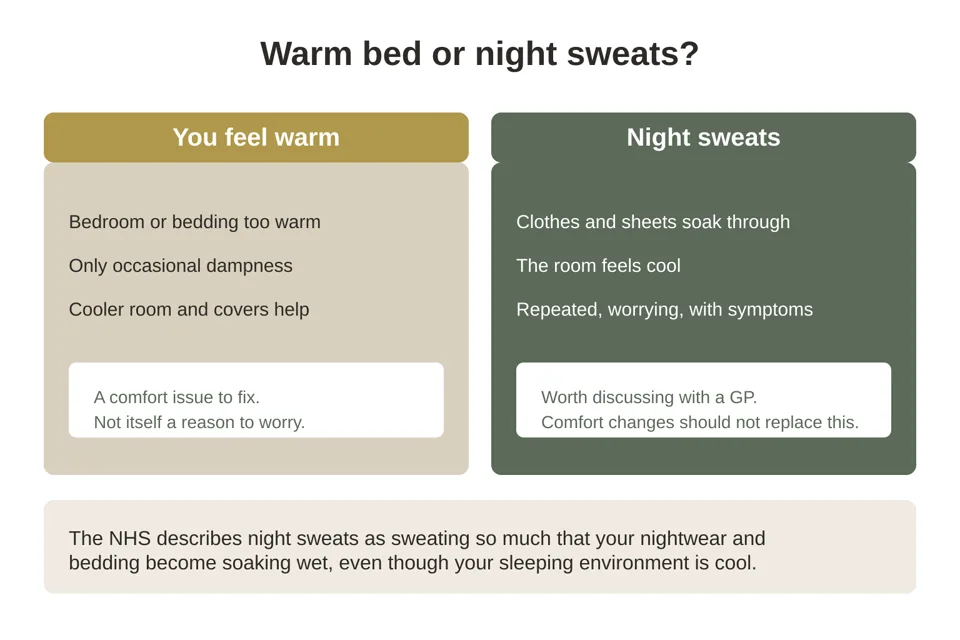
There is no home checklist that can rule out every cause. The distinction simply helps you describe the problem and choose a next step. It should not become another test you feel you have to pass before seeking advice.
If heat seems to be the immediate issue, our bedroom environment guide covers the wider sleep setup.
What can cause night sweats?
The NHS lists menopause symptoms, anxiety, some medicines, low blood sugar, alcohol or drug use, and excessive sweating called hyperhidrosis among the most common reasons. Sometimes the cause is unknown.
Several possibilities may seem to fit your circumstances. A list of causes cannot tell you which one applies, and a familiar explanation does not make other symptoms irrelevant. Tell a clinician about the whole pattern, including anything that has changed recently.
Could it be perimenopause or menopause?
Night sweats can happen during perimenopause and menopause. The NHS describes hot flushes as a sudden feeling of heat or cold in the face, neck and chest. They can cause sweating, and they can happen during the day or at night.You may also notice changes to your periods, difficulty sleeping, mood changes or problems with concentration. Experiences vary, so you do not need every symptom on a menopause list for the conversation to be worth having.
If you think this might explain your nights, ask your GP about your options. Mention the sweating itself and how it affects your sleep. You might fall asleep without difficulty, for example, but wake repeatedly because you need dry clothes.
The NHS suggests lightweight clothing and a cool bedroom, and measures such as a fan or cool shower, to ease menopausal hot flushes and night sweats. It also suggests identifying potential triggers, which can include caffeine, hot drinks, spicy food and alcohol.
Choose adjustments that fit what you have noticed. There is no need to remove every possible trigger at once. Persistent or disruptive symptoms deserve a discussion about support, even if cooling the room helps a little.
Can anxiety make me sweat at night?
Anxiety is one of the causes listed by the NHS. If you are also lying awake worrying, mention both problems when you ask for advice.Try to describe the timing without deciding what it proves. Did you wake already sweaty? Were you awake and anxious before you felt hot? Is the same thing happening on calmer nights?
Those observations help you explain your experience. They cannot establish that anxiety is the cause. Avoid dismissing new or repeated soaking sweats as stress, especially if you also have the symptoms in the "See a GP if" list.
For the worry that keeps you awake afterwards, our guide to racing thoughts at night addresses that separate part of the evening.
Could a medicine be involved?
Some antidepressants, steroids and painkillers can cause night sweats, according to the NHS. That does not mean every medicine in those groups will cause sweating, or that your prescription explains your symptoms.If the sweating started after you began a medicine or your treatment changed, make a note of the timing. A pharmacist can help you check information about possible side effects, and your GP can review the situation.
Do not stop or change a prescribed medicine yourself. The NHS says a GP may prescribe a different medicine if they think the current one is causing night sweats. That decision belongs in a medication review, with the reason for your treatment taken into account.
Bring a list of everything you take, including non-prescription products and supplements. If you have forgotten when the sweating began, say so. An approximate account is more useful than inventing a precise date.
Can alcohol cause night sweats?
Alcohol or drug use is another cause listed by the NHS. Alcohol also appears in its advice about common causes of insomnia.If you notice sweaty nights after drinking, record that pattern. Include nights when you did not drink, rather than noting only the nights that fit your suspicion. This makes your notes more useful when you discuss them.
A pattern is a clue, not proof that alcohol is the only explanation. Regular soaking sweats still deserve medical advice, particularly if they worry you or come with other symptoms.
Our article on alcohol and sleep looks at the separate question of using a drink to help you drop off.
Could it be low blood sugar?
Low blood sugar, also called hypoglycaemia, can cause sweating. Other symptoms can include shaking, hunger, dizziness, a fast heartbeat and confusion.The NHS says it usually affects people with diabetes who take insulin or some other diabetes medicines. It is rare in people without diabetes. Sweating alone is not enough to conclude that your blood sugar has dropped.
If you have diabetes and suspect low blood sugar, follow the treatment plan agreed with your diabetes team and the NHS guidance linked in Sources. Speak to your GP or diabetes team about episodes at night. Do not try to manage a suspected hypo by changing your duvet or taking a sleep aid.
If you do not have diabetes but get symptoms such as shaking, sweating, a fast heartbeat and feeling confused, the NHS advises seeing a GP. Someone who is unconscious or not responding normally needs urgent help.
Why do I sweat at night when the room is cold?
A cool room does not rule out night sweats. In fact, the NHS definition specifically describes soaking clothes and bedding despite sleeping somewhere cool.
Check the bedding as well as the air temperature. A room can feel chilly while the covers make you too warm. If you remain soaked with lighter bedding, or the episodes regularly wake you or worry you, speak to a GP.
Try not to keep lowering the room temperature to chase a diagnosis. NHS guidance lists a room that is too hot or too cold as a common cause of poor sleep. Aim for comfort while getting repeated unexplained sweating checked.
Are night sweats different in men and women?
Night sweats can affect men and women. Menopause and perimenopause are relevant possibilities for people going through those changes, but the NHS list also includes causes that are not specific to menopause.
A man with regular soaking sweats needs the same attention to the pattern and accompanying symptoms. A woman should not have to assume every sweaty night is hormonal. Medicines, alcohol, anxiety and other possibilities may still be relevant.
Tell your GP what you have noticed rather than trying to select the right explanation in advance. If menstrual changes or hot flushes are part of the picture, mention them. If they are not, that is useful information too.
What can I do tonight if I wake up sweating?
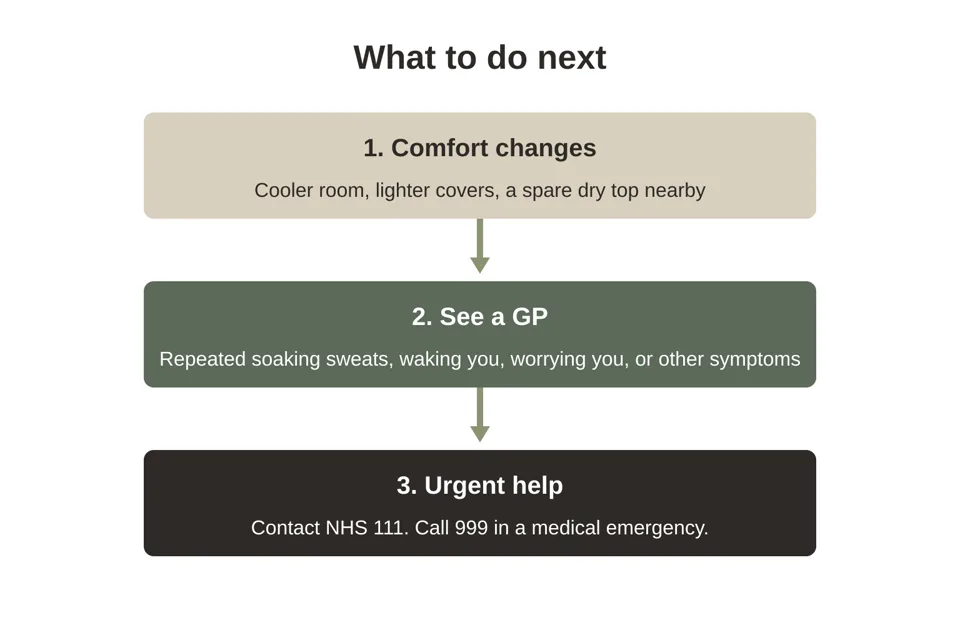
If you are otherwise well and seem to be overheating, make the bed more comfortable. If you are having repeated soaking sweats, use these measures for comfort while arranging appropriate advice.
Make dry clothes easy to reach. Keeping a spare top or set of nightwear nearby is a practical way to deal with a sweaty waking. You can change without searching through a drawer in the dark.
It does not treat the cause. It simply helps you cope with the immediate discomfort while you work out whether this is occasional overheating or a repeated problem.
Adjust the covers before buying anything. Try lighter bedding or remove an extra blanket if your current covers make you too warm. For menopausal night sweats, NHS advice supports lightweight clothing and keeping the bedroom cool.
You do not need a special mattress, supplement or expensive cooling product to begin noticing whether your bed is too warm. Keep the adjustment simple enough that you can describe what changed.
Keep the rest of the night quiet. If changing clothes leaves you fully awake, a quiet activity such as reading may be easier than searching through frightening lists of possible illnesses. NHS sleep advice recommends a dark, quiet bedroom and relaxing before bed.
If waking itself is becoming a repeated difficulty, our guide to waking in the night covers that problem in more detail. Sweating that needs assessment should still be addressed separately.
What should I record before a GP appointment?
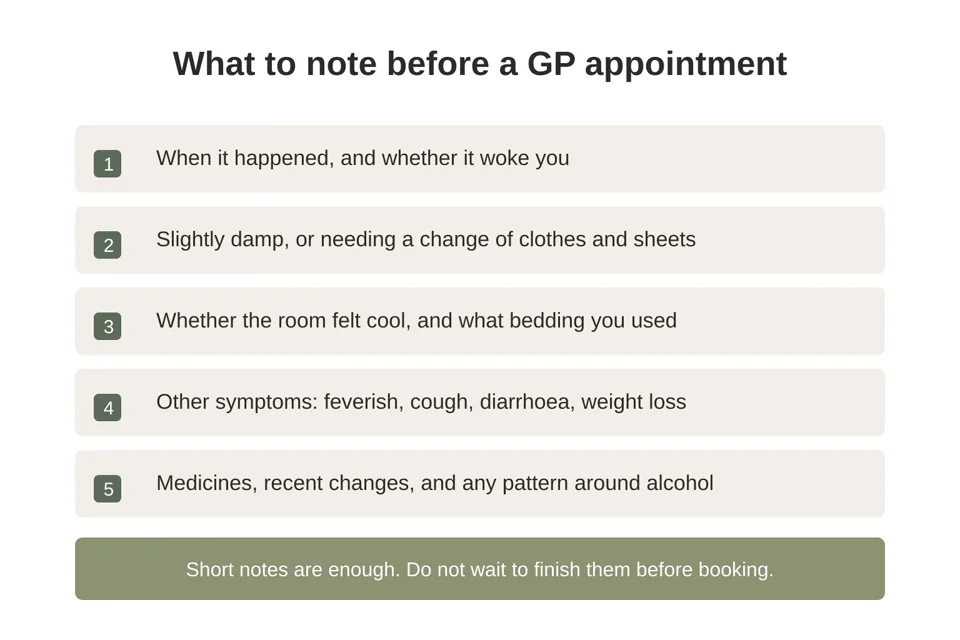
A brief record can help you explain what happens. You do not need a detailed spreadsheet, a wearable device or a week of perfect observations before booking.
- When the episodes happened and whether they woke you.
- Whether you felt slightly damp or needed to change clothes and sheets.
- Whether the room felt cool and what bedding you used.
- Any feverish feeling, cough, diarrhoea or unexplained weight loss.
- Medicines, recent treatment changes and any pattern around alcohol.
- Hot flushes, period changes or other symptoms you want to discuss.
- How the broken sleep affects your day.
A short entry might read: "Woke twice with wet pyjamas. Room felt cool, light duvet. Changed my top. No other symptoms noticed." That is an example of a description, not a test you have to pass.
Our free seven-day sleep diary can help you record waking and daytime tiredness alongside your notes. Do not delay an appointment to finish it.
When should I get help rather than keep changing my bedding?
Book a GP appointment if the sweating regularly wakes you, worries you, or leaves your clothes and sheets soaking wet. Also follow the NHS advice above if you have feverish symptoms, a cough, diarrhoea or unexplained weight loss.
Sleep disruption is worth mentioning in its own right. NHS guidance advises seeing a GP if changing sleeping habits has not helped, you have had trouble sleeping for months, or the problem makes daily life hard to cope with.
If someone notices that your breathing stops and starts, or you make gasping, snorting or choking noises in your sleep, tell your GP. The NHS identifies these as sleep apnoea symptoms. Sweating by itself does not establish sleep apnoea, but observed breathing problems should not be overlooked while you discuss the sweaty nights.
For an urgent health problem when you are unsure what to do, contact NHS 111. Call 999 in a medical emergency.
At your appointment, describe the sweating, the sleeping conditions and any other symptoms. You do not need to arrive with the answer. The NHS says a GP will check for other symptoms and consider whether a medicine could be involved. Those details give the conversation a useful place to start.
Sources & references
The health information in this guide is based on these sources. Links open in a new tab.
- NHS: Night sweats
- NHS: Symptoms of menopause and perimenopause
- NHS: Things you can do to help menopause and perimenopause symptoms
- NHS: Low blood sugar (hypoglycaemia)
- NHS: Insomnia
- NHS: Sleep apnoea
- NHS: When to use NHS 111 online or call 111
Sources last checked: 30 September 2026. Read how we use evidence.