
Sleep problems / Field guide
Menopause and Sleep: Why You Keep Waking Up and What Can Help
Perimenopause and menopause can change sleep in several ways. Here is how to work out what is disturbing your nights, what may help, and when to ask for support.
The short answer
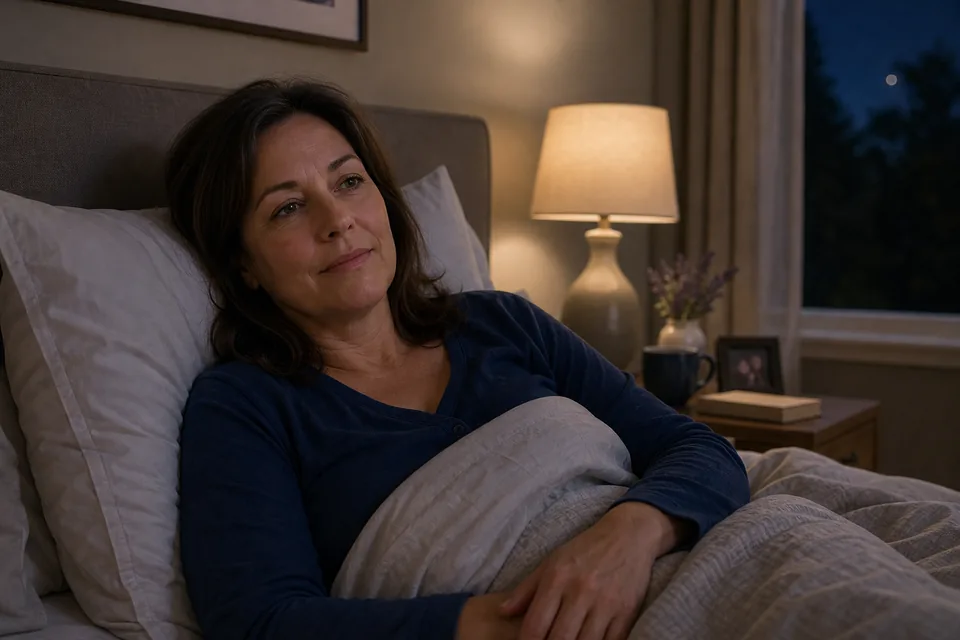
Perimenopause and menopause can make sleep noticeably more difficult. You may take longer to fall asleep, wake repeatedly during the night, wake hot and sweaty, or simply feel that your sleep has become lighter and less refreshing.
Hot flushes and night sweats are part of the explanation for many people, but they are not the whole story. Mood changes, anxiety, discomfort and changes in your normal sleep pattern can all contribute.
The useful thing is to work out what is actually disturbing your sleep, rather than assuming every bad night needs the same solution. Keeping the room comfortable, reducing obvious triggers and using ordinary insomnia strategies can help. If symptoms are persistent or affecting daily life, menopause-specific treatment and cognitive behavioural therapy may also be worth discussing with your GP.
One of the frustrating things about menopause-related sleep problems is that they do not always arrive in one neat form.
You might have slept reasonably well for years and suddenly find yourself awake several times a night.
Or you might fall asleep normally but wake at 2am feeling hot, restless and completely alert.
For someone else, the problem is getting to sleep in the first place.
The NHS recognises difficulty getting to sleep and staying asleep as common symptoms of perimenopause and menopause. It also notes that poor sleep can leave you feeling more irritable, anxious and tired during the day.
That can create a fairly miserable loop. You sleep badly, feel wrung out the next day, start worrying about another bad night, and bedtime gradually becomes something you think about far more than you ever wanted to.
The first step is to separate the menopause symptoms disturbing your sleep from the sleep problem that develops around them.
They can overlap, but they are not quite the same thing.
Are hot flushes and night sweats waking you up?
For many people, this is the most obvious part of the problem.
A hot flush can cause a sudden feeling of heat, sweating, palpitations or anxiety. When it happens at night, you may wake because you are hot, uncomfortable or damp.
Sometimes the sequence is obvious.
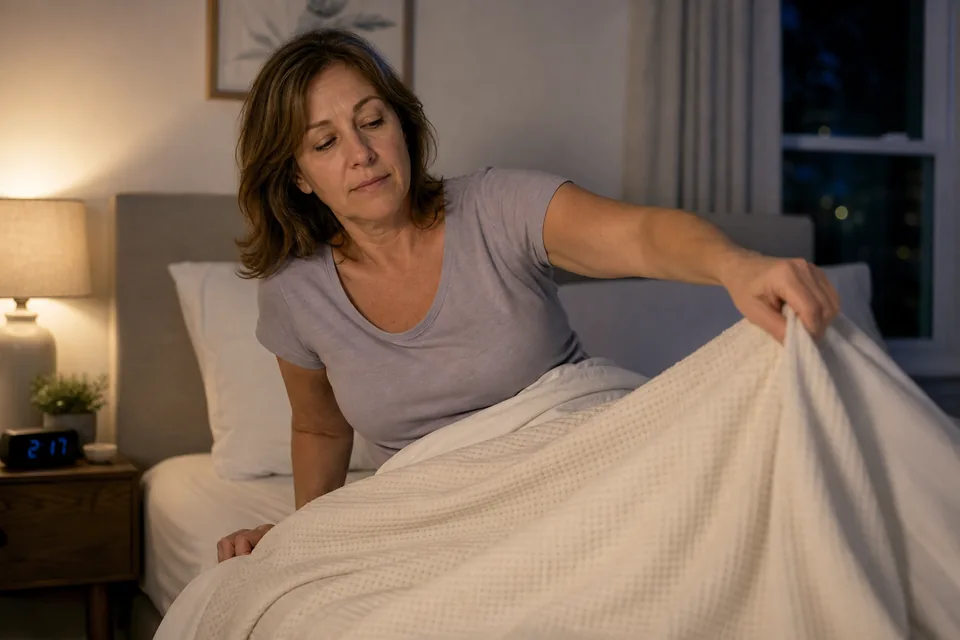
You wake drenched in sweat, throw the duvet off and know exactly what woke you.
Other times it is less clear. You may simply remember waking repeatedly and notice in the morning that you were warmer than usual.
If sweating is the main feature, it is worth distinguishing menopause-related night sweats from simply sleeping in a room that is too warm.
Genuine night sweats can soak night clothes or bedding even when the bedroom itself is comfortably cool.
If night sweats are new, severe, unexplained or happening alongside symptoms such as fever, persistent cough or unexplained weight loss, speak to a GP rather than assuming menopause is responsible.
Our separate guide to why you sweat at night looks more closely at that distinction.
Menopause does not mean every awakening is hormonal
This is important because menopause can become an easy explanation for everything that changes in midlife.
You may indeed be waking because of hot flushes.
But you can also wake because you need the toilet, your partner snores, pain is bothering you, alcohol has disrupted the second half of your night, your bedroom is too warm, or your mind has become very active once you are awake.
Sometimes one thing starts the awakening and something else keeps it going.
Imagine that a hot flush wakes you at 3am.
The flush passes after a few minutes, but now you are lying there thinking: Here we go again. I’m going to be exhausted tomorrow.
Twenty minutes later you are checking the clock.
Half an hour after that, you are wondering whether you should get up.
At that point the original hot flush and the continuing wakefulness have become two slightly different problems.
Treating menopause symptoms may help reduce the awakenings. Learning how to respond differently when you are awake may help prevent those awakenings turning into long, stressful stretches of insomnia.
If repeated waking is the main pattern, our guide to waking up at night goes into that problem in more detail.
Why can your mind feel more awake at night?
Perimenopause and menopause can also affect mood.
Some people notice more anxiety, low mood, irritability or a sense that they are less able to brush off things that would previously have passed.
That does not mean every middle-of-the-night worry is caused by hormones.
It does mean that sleep, mood and menopause symptoms can feed into one another.
A difficult night makes worries feel louder. Anxiety about sleep makes it harder to settle. Feeling tired the following day can make ordinary problems feel heavier.
Try not to make “switching your mind off” the goal.
That phrase sounds helpful but can quickly become another impossible sleep task.
If you are exhausted but then lie awake at bedtime, our guide to what to do when you can’t fall asleep covers that pattern directly.
Keep the bedroom cool, but do not turn it into a freezer
If heat is waking you, the obvious response is to make the sleeping environment easier to adjust.
The NHS suggests measures such as wearing lightweight clothing, keeping the bedroom cool, using a fan and reducing things that seem to trigger hot flushes.
That does not mean there is one perfect bedroom temperature you need to achieve.
Comfort is the goal.
Layers can be useful because they are easier to adjust than one heavy duvet. Breathable nightwear can make it easier to cool down after sweating. If you share the bed with someone who prefers more warmth, separate duvets or an extra blanket on their side may be more practical than arguing with the thermostat every night.
Keep water nearby if you find that useful, but there is no need to turn every awakening into a full bedtime routine.
Make the adjustment you need and give yourself a chance to settle again.

Look at caffeine and alcohol before adding another sleep remedy
Neither caffeine nor alcohol causes menopause, obviously.
But both can complicate a night that is already fragile.
The NHS suggests reducing potential hot-flush triggers such as caffeine, hot drinks and alcohol if you notice they affect you.
Caffeine can also make it harder to fall asleep in its own right.
Alcohol can be deceptive because it may make you feel sleepy initially, then contribute to lighter, more broken sleep later in the night.
That matters when you are already prone to waking.
You do not necessarily need to give either up completely.
A more useful test is to notice your own pattern.
If you regularly have an evening drink and then wake hot and alert during the night, try moving it earlier or having a few alcohol-free evenings and see whether the night changes.
If your afternoon coffee seems harmless but bedtime has become difficult, our guide to how long before bed to stop caffeine can help you run a sensible trial without banning every cup of tea you enjoy.
And if alcohol seems to make the second half of your night more broken, see how alcohol can affect sleep later in the night.
Should you go to bed earlier because you are exhausted?
This is tempting.
You have been awake half the night for three days running and by 8pm you can barely keep your eyes open.
So you decide to go to bed at 8.30 instead of 10.30.
Sometimes that works because you genuinely need sleep.
But repeatedly stretching your time in bed can also mean spending more time awake there.
That is especially unhelpful if lying awake has already become frustrating.
Try to separate being tired from being sleepy.
Feeling drained, irritable and low on energy after a broken night does not always mean your body is ready to sleep unusually early.
Keep your bedtime reasonably flexible and look for actual sleepiness: heavy eyelids, repeated yawning, losing your place while reading, or genuinely struggling to stay awake.

What if you wake at the same time every night?
A repeated clock time can feel strangely significant.
People often say things like: “I wake at 3.17 every morning now.”
It is understandable to wonder whether your hormones are somehow programmed to wake you at that exact moment.
Usually, the clock time itself is less important than what is happening around the awakening.
Was there a hot flush?
Did you need the toilet?
Was the room warm?
Did your partner move?
Had you been drinking alcohol?
Did you simply surface into wakefulness and then notice the clock?
Try not to turn the precise time into something you monitor.
The more often you check it, the more memorable that time becomes.
What about naps after a dreadful night?
After several broken nights, a daytime nap can feel irresistible.
Sometimes a short nap can help you function.
But the decision depends partly on how sleepy you are and partly on how much you want to protect your chance of sleeping that night.
If you are genuinely fighting sleep, safety comes first.
Do not drive or carry on with something risky simply because you are worried that a nap will spoil bedtime.
If you are tired but comfortably awake, a long or late nap may make bedtime harder.
There is no need to guess. Our guide to whether you should nap after a bad night’s sleep walks through that decision separately.
Can CBT really help menopause-related sleep problems?
CBT can be useful for some menopause-related sleep problems.
The NHS includes cognitive behavioural therapy among the options that may help with problems linked to menopause, including sleep difficulties, low mood and anxiety.
This is worth understanding because CBT is sometimes misunderstood as someone simply telling you to “think positively”.
It is more structured than that.
For sleep problems, CBT can work on the behaviours and thought patterns that keep insomnia going, such as spending very long periods awake in bed, worrying about how much sleep you will get and becoming increasingly watchful for signs that another bad night is coming.
It will not remove every hot flush or guarantee perfect sleep, but it can give you a more useful way to deal with the sleep problem that develops around repeated waking.
If poor sleep has become persistent, it is reasonable to ask your GP whether CBT or another form of support might suit you.
Rested Review also has a fuller guide to CBT-I if you want to understand how structured insomnia treatment works.

Can menopause treatment make sleep easier?
If hot flushes and night sweats are the main reason you keep waking, treating those menopause symptoms may make your nights easier too.
That does not mean every sleep problem during menopause needs hormone treatment.
Some people are mainly dealing with temperature changes. Others have anxiety, repeated waking, pain, snoring or a separate insomnia pattern as well.
Your GP, nurse or menopause specialist can talk through the treatment options that fit your symptoms and medical history, including whether HRT is appropriate for you.
It is better to make that decision as part of the wider menopause picture rather than judging a treatment solely by one good or bad night of sleep.
Be careful with “natural menopause sleep remedies”
When sleep goes downhill, supplements and herbal menopause products have an obvious appeal.
They are easy to buy and are often marketed as gentler than medical treatment.
The difficulty is that “natural” does not automatically mean effective or risk-free.
The NHS advises caution with complementary and herbal remedies because they can have side effects and can interact with other medicines.
That does not mean every product is useless.
It means you should be cautious about taking several things at once because an advert promises hormone balance or deeper sleep.
If you take regular medicines or have a medical condition, a pharmacist is a sensible person to ask before adding a supplement.
And if the real problem is repeated hot flushes, night waking or persistent insomnia, it makes more sense to address that directly than to keep adding sleep products.
Try a simple seven-night menopause sleep check
You do not need a wearable.
For seven mornings, write down just four things:
- How the night went: settled easily, took a while, woke once, woke repeatedly or woke early.
- What seemed to wake you: hot flush, sweating, toilet, noise, pain, thoughts, partner, unclear.
- How you felt on waking: refreshed, groggy, exhausted or still sleepy.
- Anything obviously different: alcohol, late caffeine, illness, unusual stress, medication change or a particularly hot room.
Do not record every minute.
You are looking for a pattern, not building a scientific experiment.
At the end of the week, you may notice that almost every difficult night includes sweating. Or that the sweating happens occasionally but your longer awakenings are mostly spent worrying. Or that the whole pattern is much less predictable than you assumed.
All three are useful information.
And if keeping records makes you more preoccupied with sleep, stop.
You do not need a perfect diary before asking for help.
When should you speak to a GP?
Speak to your GP if menopause symptoms are affecting your sleep, mood, work or daily life.
You do not have to wait until they become unbearable.
It is also worth getting advice if you are unsure whether the symptoms are actually due to menopause.
See a GP about night sweats that regularly soak your bedding, particularly if they come with other unexplained symptoms.
Mention loud snoring, gasping, choking, witnessed pauses in breathing or marked daytime sleepiness too. Menopause does not rule out another sleep condition.
And if poor sleep has been going on for months, tell your GP what happens both during the night and during the day.
That makes the conversation much more useful than simply saying, “I don’t sleep well.”
The main thing to take away
Menopause can genuinely disrupt sleep.
You are not necessarily imagining a change just because you used to sleep well.
But it is still worth being specific about what is happening.
A hot flush waking you is different from lying awake worrying for two hours. Feeling tired the next day is different from repeatedly fighting sleep. A warm bedroom is different from soaking night sweats.
Once you separate those pieces, the next step becomes clearer.
You might need a cooler and easier-to-adjust bedroom.
You might need to look at caffeine or alcohol.
You might need help with persistent insomnia.
Or you might want to talk to your GP about menopause treatment itself.
You do not have to solve every part of the night at once.
Put this guide in context
Choose a next step that matches the problem you actually have. Why do I sweat at night? Causes and when to see a GP offers a closer look at a connected question. If you are unsure where to begin, use the Start Here selector instead of trying several changes at once.
These suggestions are written for adults and need adapting to your health, responsibilities and living arrangements. A short morning note can help you describe a pattern, but keeping records is optional. You do not need to collect perfect evidence before asking for help. If an experiment makes you more uncomfortable or preoccupied, stop and choose a simpler response.
This is general information, not medical advice. Seek individual guidance for symptoms, treatment decisions or medicine questions. Persistent problems and safety concerns deserve attention even if some parts of an evening routine feel helpful.
Sources & references
Clinical context and further reading. Our practical examples are editorial suggestions, not individual treatment protocols.
- NHS: Symptoms of menopause and perimenopause
- NHS: Things you can do to help menopause and perimenopause symptoms
- NHS: Night sweats
Source check: 5 September 2026. Evidence label: Practical guidance. Read how we use evidence.